Cloudflare's September 15 Deadline: What 'Content Independence Day' Means for Scrapers and AI Agents
Cloudflare blocks AI Agent and Training crawlers by default on ad-supported pages from Sept 15, 2026 — and it can catch Googlebot in the crossfire.

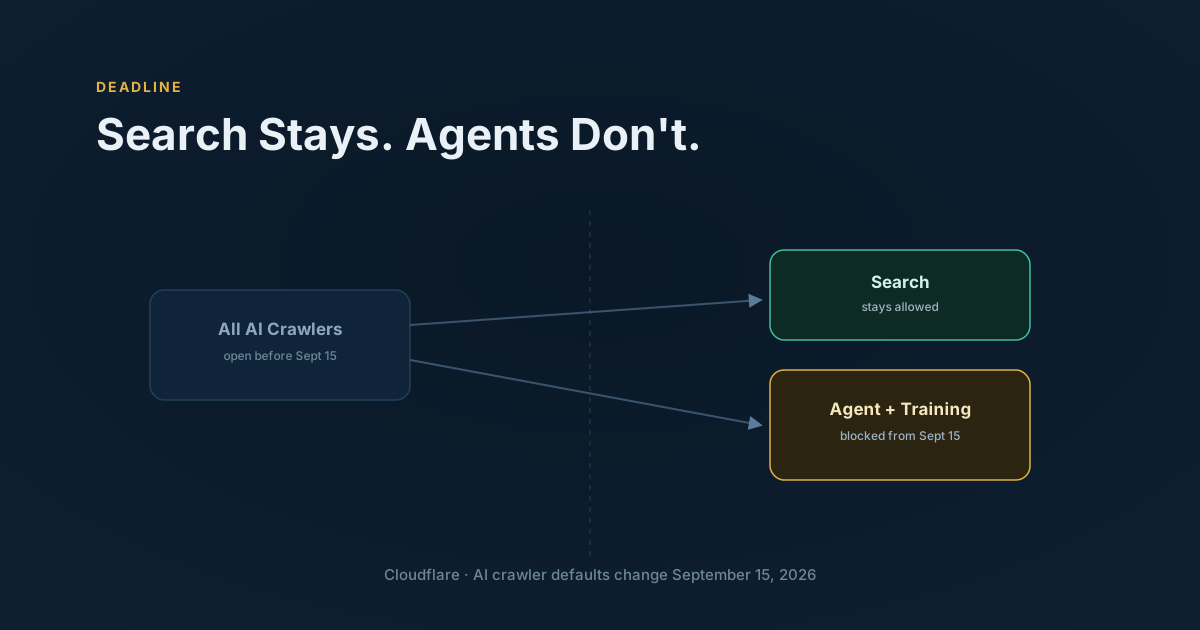
Cloudflare just turned a slow-burning conflict of interest into a hard deadline. On July 1, 2026, it published what it's calling "Content Independence Day" — a new way to classify AI crawler traffic, and a switch that flips the default access rules for most of it on September 15, 2026.
If you run a site behind Cloudflare, build anything that fetches pages at scale, or just want to understand why your analytics might look different in October, the next two months are worth paying attention to.
What Actually Changed on July 1
Cloudflare introduced three categories for AI-related crawler traffic:
| Category | What it means | Default after Sept 15 (ad-supported pages) |
|---|---|---|
| Search | Crawls to power search results and answer engines | Allowed |
| Agent | Crawls triggered live by an AI agent acting on a user's request | Blocked |
| Training | Crawls to build or fine-tune model training data | Blocked |
The classification applies per crawler, and Cloudflare is doing the categorization — not the site owner guessing from a user-agent string. Every customer, including the free tier, gets a dashboard to see which category a given AI crawler falls into and to override the default manually.
The headline change: starting September 15, Agent and Training crawlers get blocked by default on any page that carries ads. Search crawlers keep flowing. Nobody has to do anything for the new defaults to take effect — that's the part worth underlining. If you don't touch your settings, your site's behavior changes automatically on that date.
The Part That Actually Surprised People: Multi-Purpose Crawlers
Here's the mechanic buried in the announcement that's generating the most confusion.
Some crawlers aren't single-purpose. Googlebot, Applebot, and Bingbot all serve both Search and Training functions — Search crawls feed the search index; the same infrastructure (or a related one) also feeds AI training pipelines at the same company. Cloudflare's rule for these multi-purpose crawlers: they get evaluated under both policies.
That means if a site blocks Training crawlers, a multi-purpose crawler gets blocked too — even on the same page where Search crawlers are explicitly allowed.
In plain terms: a site owner trying to keep their content out of AI training sets, without realizing Googlebot is one of the crawlers caught by that same switch, could end up degrading their own Google Search visibility as a side effect. Cloudflare's dashboard does surface this, but the default behavior — one lever pulling on two outcomes — is the single most important thing to actually understand before September 15, not after.
We Called This One in March
This blog wrote about Cloudflare's entry into crawling infrastructure back in March 2026, and flagged the structural position Cloudflare was building toward: sitting on both sides of the AI content market, protecting publishers from scraping and selling the infrastructure to do it.
The prediction then was specific: "If Cloudflare builds a publisher-facing access control layer — essentially a 'verified crawlers' list that gets through Bot Management — they control the key chokepoint in the AI web content market. Publishers flip a switch to allow specific AI crawlers (for a licensing fee), and Cloudflare enforces it at the infrastructure level."
Content Independence Day is that layer, shipped. Cloudflare's Pay Per Crawl feature — which let publishers charge AI companies per page fetched — is evolving into what Cloudflare calls Pay Per Use: charging based on when content actually creates value for the AI company, not just when it's fetched. Combined with the new default-block rules, the mechanism is now live: block by default, then sell access back.
Whether that's good for the open web is a separate question from whether it's a smart business move. It's an extremely smart business move.
What This Means If You're a Publisher
Audit your Cloudflare AI Crawl Control settings before September 15, specifically:
- 02Decide what you actually want blocked. "Block all AI crawlers" is not the same decision as "block Training but keep Search" — and if you pick the former without realizing the multi-purpose crawler mechanic, you may be trading away search visibility you didn't mean to give up.
- 04Check whether your ad-supported pages are the ones you meant to protect. The new defaults only apply on pages that display ads — content behind a paywall or on ad-free pages isn't covered by this specific default flip.
- 06Watch your referral traffic in October, not just your crawl logs. If Googlebot gets caught by a Training block you set, the symptom shows up as a drop in organic search traffic weeks later, not as an obvious crawl error today.
What This Means If You Scrape for a Living
If your crawling looks like an AI lab's — broad, unauthenticated, server-side, high-volume — expect more Cloudflare-protected sites to default to blocking you starting mid-September, on ad-supported pages specifically. That's roughly 20% of the web sitting behind Cloudflare, so this isn't a rounding error.
If your crawling looks nothing like that — a single person, in their own authenticated session, pulling data from pages they can already see in their own browser — you were never really the target of this policy, and the traffic pattern reflects that. Cloudflare's classification system exists to sort automated, server-side, at-scale crawler traffic into buckets. It has no mechanism (and no reason) to flag a single browser session behaving like a single browser session.
What This Means If You Use CrawlPilot
This is worth being precise about rather than turning into a pitch: CrawlPilot is a browser extension. It runs the extraction inside your browser, using your session, your cookies, your IP — it's the same traffic pattern as you clicking around the page yourself, because that's mechanically what's happening. There's no separate server-side crawler fleet hitting Cloudflare's edge on your behalf.
That doesn't make it invisible to every anti-bot system on earth — nothing is — but it does mean Content Independence Day's Search/Agent/Training classification, which is built to categorize automated crawler infrastructure, isn't really evaluating the same thing a local, human-driven browser session is doing. It's a genuinely different traffic shape.
The Honest Caveats
- This is Cloudflare-only. Roughly a fifth of the web sits behind it, which is significant, but four-fifths doesn't. Sites on other CDNs or none at all aren't affected by this specific change.
- Defaults are overridable, in both directions. A site can choose to allow Agent and Training crawlers if it wants the AI visibility; a site can also block Search crawlers if it wants to disappear from AI answer engines entirely. September 15 sets the default, not a mandate.
- This doesn't resolve the underlying legal ambiguity around what crawling is lawful in the first place. A federal court ruled earlier in 2026 that
robots.txtisn't a DMCA "technological protection measure" at all — meaning ignoring it isn't automatically the legal violation a lot of people assume it is. Cloudflare's rules are a private company's access-control defaults enforced at the infrastructure layer, which is a separate question from what the law actually requires. See our legal guide to web scraping for the broader framework, though it predates this specific ruling. - The classification itself is Cloudflare's call. There's no independent audit of which crawlers land in which bucket — you're trusting Cloudflare's categorization the same way you're trusting its bot-detection scores today.
What to Actually Check Before September 15
If you do one thing after reading this: log into your Cloudflare dashboard, find AI Crawl Control, and look at what's currently classified as Training versus Search for your domain. Decide on purpose whether you want the September 15 defaults, rather than finding out in October from a traffic graph.
The bigger story here isn't really about scrapers at all. It's the first real, live instance of a infrastructure company sitting at the chokepoint of the AI content economy and actually pulling the lever — not speculating about it. Whoever else builds the next version of this (and someone will) is going to look a lot like this one.