Software Entropy: Why Every Codebase Decays Over Time (And What to Do About It)
The Second Law of Thermodynamics applied to software — why complexity compounds, technical debt accumulates, and what engineering teams can actually do to fight it.

You join a codebase. It's six years old. Nobody knows who owns the auth module. There are three ways to make an API call, all slightly different. A comment says "don't touch this." The person who wrote it left in 2021.
This is not bad engineering. This is physics.
The Second Law of Thermodynamics says: in any closed system, disorder always increases over time. You cannot stop it. You can only slow it down — and only by putting in energy.
Codebases are closed systems. And they follow the same law.
Fresh Code vs. Old Code
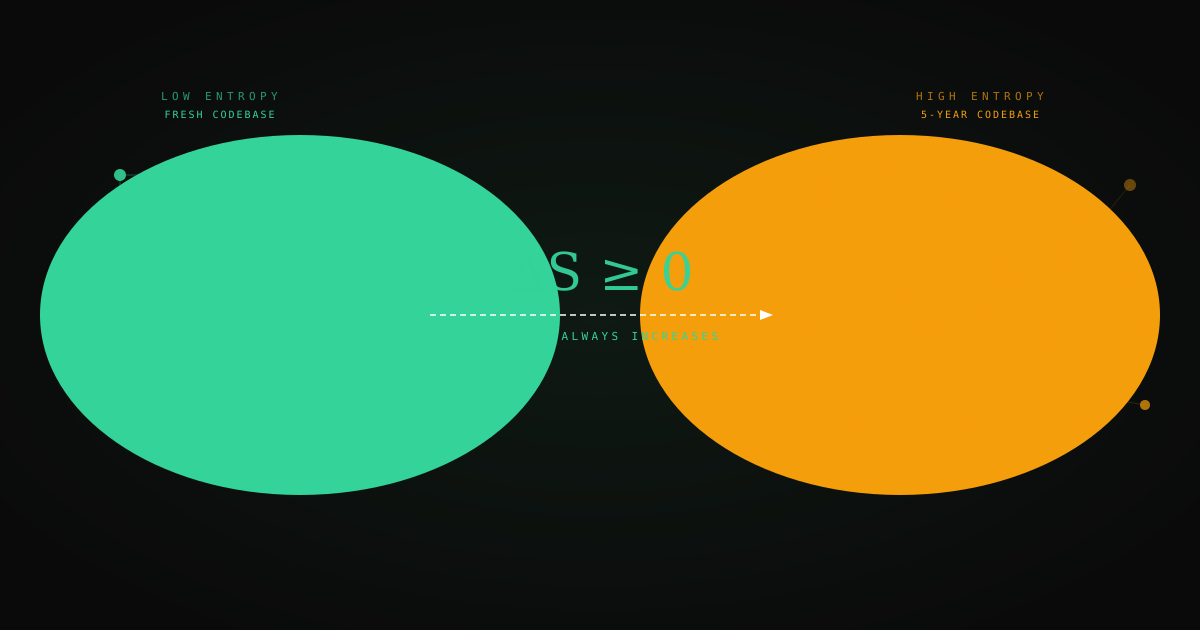
A new codebase is like a crystal. Clean structure. Clear ownership. One way to do each thing. A five-year-old codebase that has shipped features, survived incidents, and absorbed twenty different engineers — that's a gas. Modules reach into each other. The same concept is implemented three different ways. Nobody has the full picture.
The transition from crystal to gas is entropy. It happens automatically, without anyone making bad decisions.
Technical Debt Compounds — It Doesn't Just Accumulate
The "debt" metaphor is useful but misleading. Financial debt stays flat if you stop borrowing. Entropy compounds.
A messy module attracts more mess. Engineers under pressure pattern-match to what's already there. If errors are handled inconsistently, new code handles them inconsistently. If a cross-cutting concern has no clear owner, it gets duplicated.
This is why codebases that feel fine at year two feel unmanageable at year five — even if the rate of new features hasn't changed. The disorder is compounding in the background.
The Legacy System Is Heat Death
Physics has a concept called "heat death" — the theoretical end state where everything has reached maximum disorder and nothing useful can happen.
Every engineering org has a version of this: the system nobody touches. Changing one line requires a week of archaeology. The original engineer left three companies ago. The wiki link 404s.
That system is technically alive, but thermodynamically dead. Extracting useful work from it — adding a feature, fixing a bug cleanly, onboarding a new engineer — costs more energy than it should. And it stays that way unless someone deliberately pumps energy back in.
Your Tests and Code Reviews Are Maxwell's Demon
In 1867, physicist James Clerk Maxwell imagined a tiny demon sitting at a gate between two chambers of gas. The demon watches molecules and only lets fast ones through one side — reducing entropy without seemingly doing work.
Maxwell's Demon was eventually debunked. The demon has to observe molecules, which costs energy. Reducing disorder always costs something.
Your CI pipeline is Maxwell's Demon. Tests, code reviews, linters — these catch disorder at the gate before it compounds. A failing test that catches a regression is entropy detection. A reviewer asking "why is this handled differently from everywhere else?" is entropy reduction.
But notice: this is not free. Tests have to be written and maintained. Reviews take time. You pay the cost either way — upfront in discipline, or later in an unmaintainable system.
Refactoring Is Adding Energy to the System
To lower entropy in a physical system, you have to do work. A refrigerator moves heat from cold to warm — it doesn't destroy entropy, it exports it.
Refactoring is the same. You're reorganising accumulated complexity, making it legible, exporting disorder into deleted code. It takes time. It often makes things temporarily messier before they're better. This is why refactoring is always uncomfortable — not because something went wrong, but because thermodynamics requires it.
If your team never has time to refactor, entropy is compounding. You're not moving faster. You're borrowing against a debt that doesn't stay flat.
Open Systems: The Way Out
The Second Law applies to closed systems. Open systems — ones that exchange energy with their environment — can maintain local order as long as they export disorder outward.
A living cell takes in food and outputs heat. Locally, it maintains extraordinary order. The same principle applies to software:
Clear module boundaries contain entropy. When a module has a well-defined interface and one responsibility, its internal disorder can't spread. You can refactor it without touching anything else.
Microservices, done right, are open systems. Each service evolves independently. Disorder in one doesn't infect the others.
The strangler fig pattern is a controlled phase transition. You run old and new systems in parallel, gradually shifting traffic to the new one. It's expensive and uncomfortable — but it's a deliberate transition, not a catastrophic one.
The Three Mistakes Teams Make
Treating entropy as optional. "We'll clean it up when things slow down." Things don't slow down. Entropy doesn't wait.
Thinking a rewrite fixes it. A rewrite resets the clock, but it has the same entropy dynamics as the original system. If you rebuild without changing the processes that created the disorder, the new system reaches the same state in roughly the same time.
Optimising for zero entropy everywhere. Some entropy is fine. A startup writing perfectly clean code for features that might not survive the next pivot has made a bad trade. The goal is low entropy in the things that need to last — not everywhere.
What You Can Actually Do
1. Invest in your Maxwell's Demons early. Tests, linting, code review norms, architecture decision records. These are entropy gates. Expensive to set up, cheap to run, and the return compounds.
2. Make the system more open. Every tight coupling is an entropy trap. Two modules sharing mutable state. Two services calling each other's internals. Add interfaces. Define ownership. Create seams where entropy can be exported.
3. Schedule refactoring like any other work. Not "when we have time" — that time never appears. A fixed allocation, like a maintenance budget. If you stop paying it, the system closes.
4. Name the entropy. "Our auth module has high entropy — here's the evidence." Making it concrete turns it from a vague feeling into something you can argue for in planning.
The Honest Ending
Every codebase reaches heat death eventually. It gets rewritten or abandoned. This is not a failure. It is thermodynamics.
What good engineering buys you is time. Time to extract useful work before the system becomes unmaintainable. Time for the product to find its shape. Time for the business to afford a proper rewrite.
The goal is not code that never decays. It's code that decays slowly enough to be useful — and doing the work, continuously, that keeps the entropy from winning ahead of schedule.