LangGraph vs CrewAI vs AutoGen in 2026: The Multi-Agent Framework Race Just Narrowed
A dozen multi-agent frameworks competed in 2024. In 2026 it's three, and they're not really competing on the same thing anymore. Here's the honest breakdown.

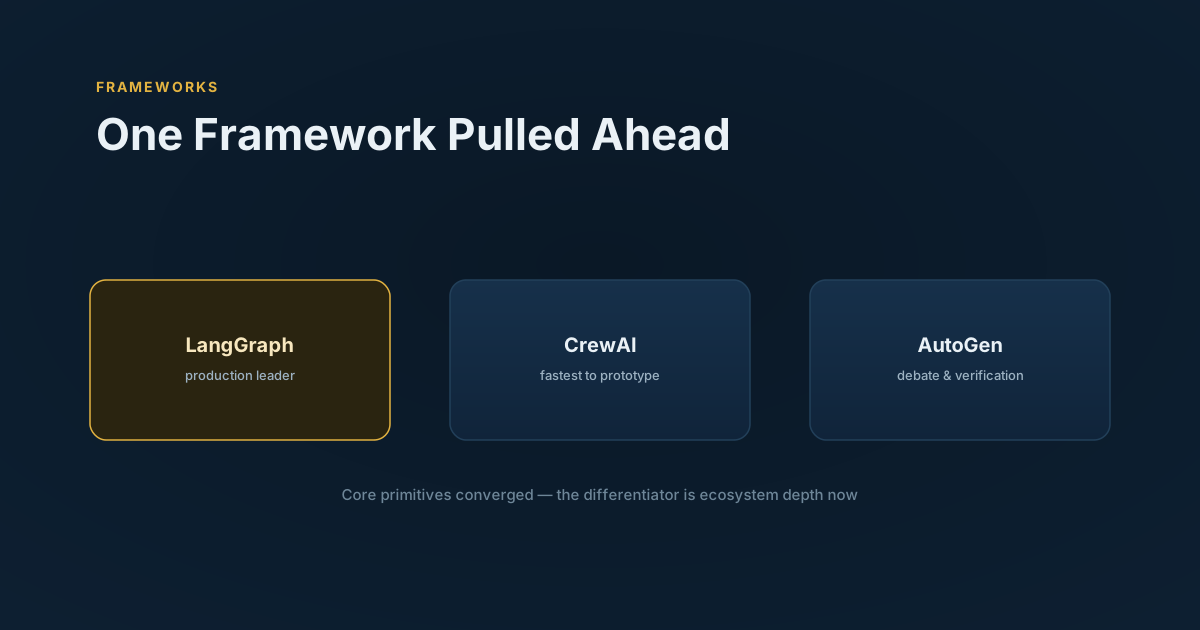
Two years ago, picking a multi-agent framework meant evaluating a dozen credible options, most of which would be effectively abandoned or merged into something else within eighteen months. That consolidation happened. By 2026, the practical shortlist for production multi-agent systems is three frameworks — LangGraph, CrewAI, and AutoGen — and the more useful finding isn't which one "won." It's that they stopped competing on the same axis.
LangGraph: The Production Default
LangGraph has the largest production deployment footprint of the three in 2026, and it's become the default choice for enterprise multi-agent systems specifically because of its architecture, not just its ecosystem size. It models multi-agent execution as an explicit graph — nodes are steps, edges are transitions, and state persists across the whole run.
That explicit graph structure is what production teams actually need and what a looser "agents talking to each other" model doesn't naturally provide: audit trails (you can see exactly which path a run took), rollback points (you can resume from a checkpoint instead of re-running an entire multi-step task), and human-in-the-loop gates built into the execution model rather than bolted on. LangGraph reached v0.4 in April 2026 with improved state persistence and checkpointing specifically aimed at these production requirements, and it surpassed CrewAI in GitHub stars in early 2026 — a trailing indicator of the enterprise adoption that had already been building.
CrewAI: Fast to Prototype, Still Catching Up in Production
CrewAI's actual strength hasn't changed: a role-based "crew" metaphor (a researcher agent, a writer agent, a reviewer agent working together) that maps intuitively onto how people already think about delegating work, which makes it genuinely the fastest of the three to go from idea to working demo.
CrewAI shipped enterprise-grade observability and scheduling in 2026, closing part of the gap with LangGraph. But the honest read from teams running it in production is that it still trails on production observability and error recovery relative to LangGraph's graph-based model — when something goes wrong three steps into a crew's task, understanding exactly what happened and resuming cleanly is a harder problem for CrewAI's architecture than for an explicit state graph. Use it when speed of prototyping matters more than production hardening; be honest with yourself about whether that's still true once the prototype needs to ship.
AutoGen: The Research Framework That Does One Thing Production Doesn't
AutoGen reached 1.0 GA in 2026 with the v2 API as default, alongside real architectural improvements. Its actual niche is distinct from the other two: multi-agent debate and verification patterns — agents that argue with each other, cross-check each other's outputs, or reach consensus through structured disagreement. Microsoft's own research and academic adoption of AutoGen leans heavily on exactly this pattern.
Production adoption is smaller than LangGraph's or CrewAI's, and that's not really a failure — debate-and-verification workflows are a narrower use case than "run a multi-step task with checkpoints" or "delegate work across role-based agents." If your actual problem is agents checking each other's work rather than agents completing a linear or branching task, AutoGen is worth a real look even though it's the smallest production footprint of the three.
The Real 2026 Trend: Convergence on Primitives, Differentiation on Ecosystem
All three frameworks now support broadly similar core primitives — persistent state, tool calling, human-in-the-loop gates, some form of checkpointing. That convergence is the actual headline, more than any one framework's individual feature list: the frameworks are no longer competing on "can you do X at all," they're competing on ecosystem depth — how good the observability tooling is, how many integrations exist, how active the community is, how good the documentation and debugging experience are once something breaks at 2am.
That's a meaningfully different competitive landscape than 2024's, where the question was "which framework has the right abstraction at all." The abstractions converged; the moats moved to tooling and ecosystem.
An Honest Decision Framework
Pick LangGraph if: you're building something that needs to run in production with real audit and rollback requirements, you can tolerate a steeper initial learning curve for the graph model, and you want the framework with the deepest current enterprise adoption and tooling ecosystem.
Pick CrewAI if: you're prototyping, the role-based mental model matches your actual workflow (a genuine team-of-specialists structure), and you're not yet certain the project needs hardened production error recovery — or you're willing to invest in that gap yourself as it matures.
Pick AutoGen if: your actual problem is agents checking, debating, or verifying each other's work, not a linear or branching task pipeline — this is the one framework of the three actually built around that pattern first.
Build custom if: none of the above, which is a legitimate answer more often than framework blog posts usually admit. A well-scoped single-agent system with good tool design frequently outperforms a multi-agent framework applied to a problem that didn't actually need multiple agents in the first place.
Where Deterministic Tools Fit Into Any of These
Whichever framework orchestrates the workflow, the actual tool calls at the leaves of that graph still have to do something — read a file, query a database, or pull data off a webpage. For that last case specifically, it's worth being deliberate about what does the extraction: a general-purpose browsing agent reasoning about page structure inside your orchestration graph is slow, non-deterministic, and burns tokens on every run. A deterministic extractor that returns the same structured rows every time — the CrawlPilot model — is a better tool call to wire into any of these three frameworks when the data you need is already known and structured, freeing the orchestration layer to spend its reasoning budget on the parts of the task that actually need judgment.
The framework consolidation is a genuinely good sign for the ecosystem — fewer credible options means less time evaluating and more time building. The next round of differentiation won't be about which framework has the right primitives. It'll be about which one you can actually debug at 2am when a production run fails halfway through step six.