Prompt Injection Is the #1 AI Agent Threat in 2026 — Here's the Actual Defense Architecture
Prompt injection attacks are up 340% year-over-year. Filtering doesn't fix it. Here's the containment architecture that actually reduces the risk.

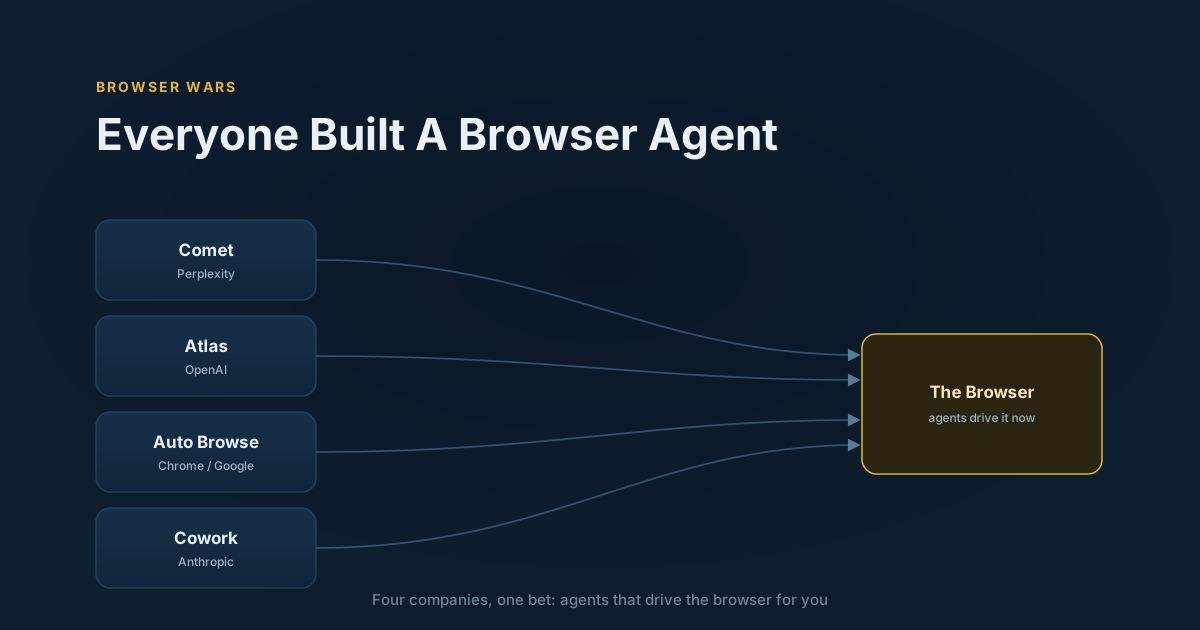
We flagged this as an open problem in the agentic browser wars post: every major AI browser agent shipped in 2026 can act inside your logged-in session, and none of them has a real fix for an agent getting hijacked by instructions hidden in the page it's reading. That gap didn't close since then — if anything, the data on how often it's being exploited got worse. This post is the deep-dive we owed on what "better guardrails" actually looks like in practice.
The Numbers Are Not Subtle
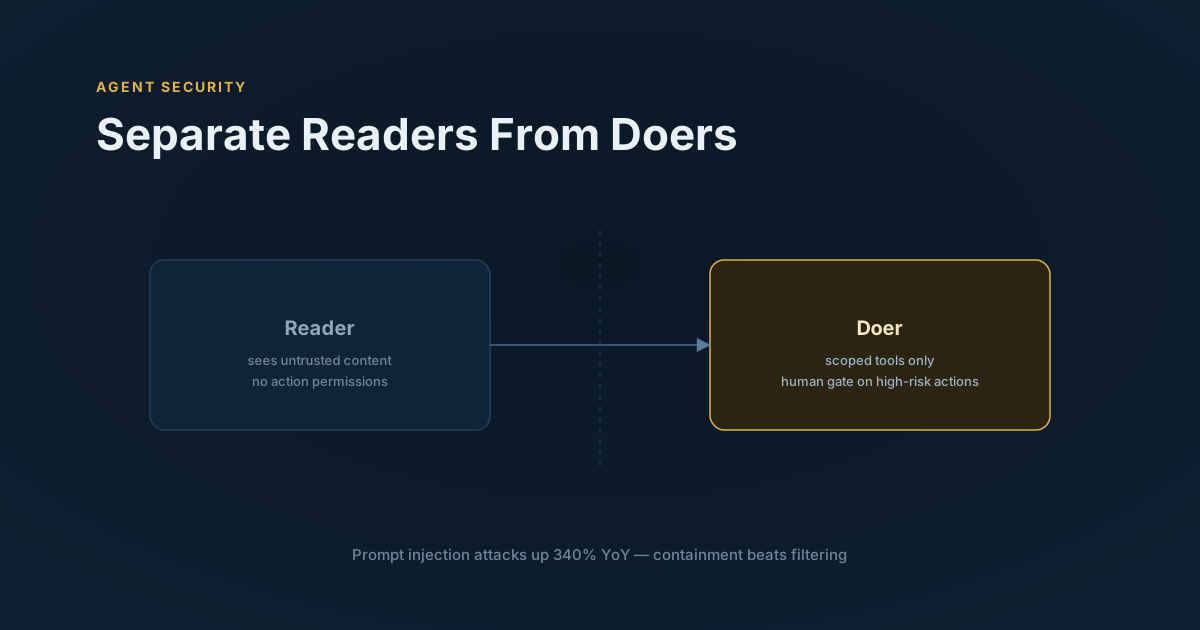
Prompt injection attacks are up 340% year-over-year as of 2026, and security researchers now rank it as the number one threat to AI systems in production — ahead of data leakage, model theft, and every other category on the list. It has become, in the words of more than one security team, one of the most reliably exploitable attack categories in real enterprise AI deployments.
The reason it's outpacing other AI security concerns is structural, not just a matter of attacker interest: agents make the attack surface much bigger than chatbots ever were. A chatbot that gets tricked by injected instructions can say something wrong. An agent that gets tricked can do something wrong — send an email, delete a file, submit a form, exfiltrate data it had access to. The blast radius scales with what the agent is allowed to touch.
The Lethal Trifecta
Security researchers use a useful framing for exactly when this becomes genuinely dangerous, sometimes called the lethal trifecta: an agent that has (1) access to untrusted content, (2) access to sensitive data or high-privilege actions, and (3) a way to communicate results externally.
Any one or two of these in isolation is usually manageable. An agent that reads untrusted web content but has no access to sensitive data and can't send anything anywhere is annoying to fool but not dangerous to fool. An agent with access to sensitive data and no path to untrusted content has nothing to be injected by. It's the combination of all three that turns a successful injection into actual harm — and modern agent stacks, especially browser-driving and MCP-connected ones, increasingly have all three by default, because that's exactly what makes them useful.
Why Filtering Doesn't Actually Work
The intuitive first fix — scan incoming content for malicious instructions and strip them out — has the same failure mode as every content-filtering arms race that came before it: spam filters, web application firewalls, antivirus signature matching. Attackers iterate faster than filter rules update, injected instructions can be encoded, obfuscated, or split across content in ways that evade pattern matching, and false positives on legitimate content create real usability costs that push teams to loosen filters over time anyway.
Filtering isn't worthless as a layer, but treating it as the defense is the mistake. The 2026 security consensus has moved decisively toward a different principle:
Containment, not filtering, is the architecture that actually reduces risk.
The Architecture That's Actually Working
The most effective defenses in production right now aren't clever prompts or better filters — they're architectural decisions made before the agent ever runs:
Label untrusted content as data, explicitly, never as instructions. When an agent retrieves a webpage, an email, or a document, that content goes into the prompt with clear framing — this is untrusted data to reference, not a set of commands to follow — rather than getting concatenated in a way that lets it read as part of the instruction stream.
Separate readers from doers. This is the single highest-leverage architectural pattern: an agent (or agent step) that processes untrusted content should not simultaneously hold the permissions to take consequential action. A "reader" summarizes or extracts from untrusted content and passes a constrained result forward. A "doer" acts on structured, already-filtered input — the raw untrusted content never reaches it. Even a fully successful injection against the reader can only manipulate what gets summarized, not directly trigger the doer's actions.
Scope tool access per task, not per agent. An agent with blanket access to "send email, delete files, make payments, browse the web" is a much bigger blast radius than one that gets exactly the tools its current task requires, provisioned narrowly and revoked after. Least-privilege isn't a new idea — it's the same principle that's governed access control for decades, applied to what used to be an ungoverned space.
Gate irreversible or high-risk actions behind a human. Sending a Slack message and issuing a refund are not the same risk category, and shouldn't be treated the same way in an agent's permission model. The actions worth automating fully are the ones where a bad outcome is cheap to detect and reverse; the ones that aren't need a human in the loop, by design, not as an afterthought bolted on when something goes wrong.
This Is Now a Compliance Question, Not Just a Best Practice
Three regulatory and standards frameworks are converging on requiring documented controls for exactly this risk category by the end of 2026:
- The EU AI Act's Article 15, with an August 2026 enforcement deadline, requires documented evidence of resilience to unauthorized manipulation for in-scope AI systems.
- NIST's AI Risk Management Framework expects documented controls for AI-specific threats.
- The ISO 42001 standard has similar expectations forming around it.
That shifts prompt injection defense from "good engineering practice" to "thing you need to be able to show an auditor," which is a meaningfully different bar. A team that can point to an explicit reader/doer separation, scoped tool permissions, and a documented human-approval gate for high-risk actions has something to show. A team relying on "we have some content filters" does not.
Where This Intersects MCP
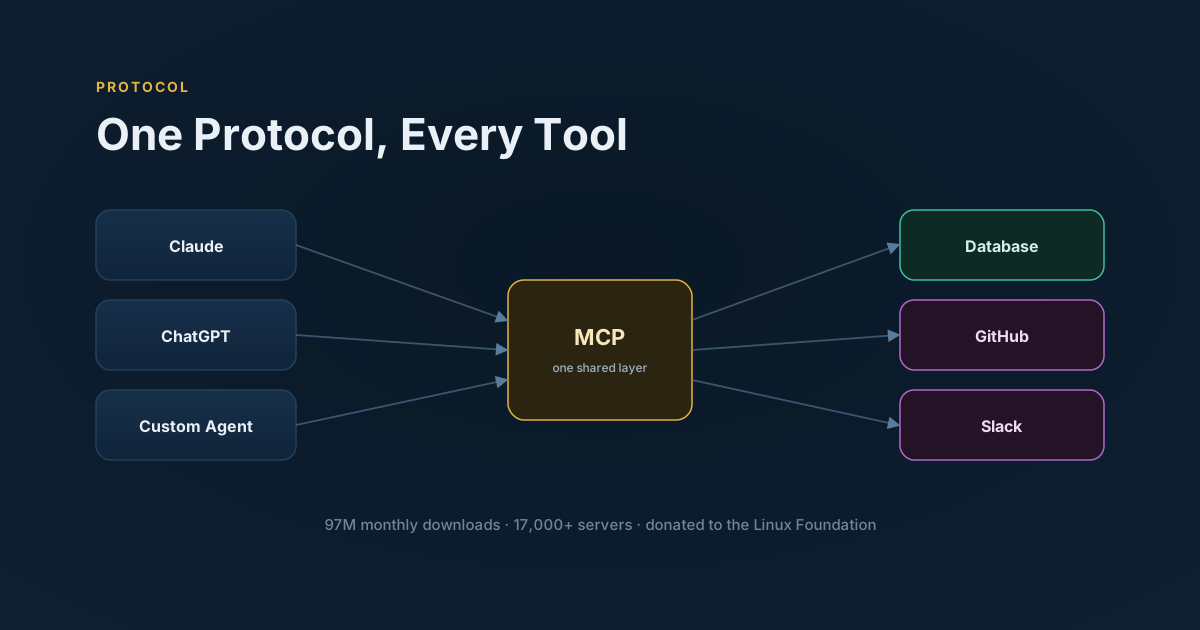
This connects directly to MCP's explosive adoption: the protocol made it trivially easy to give an agent broad, standardized tool access. That's exactly the ingredient that makes the lethal trifecta easy to accidentally assemble — an MCP server that gives an agent both content-reading and consequential-action capability, wired into an agent that also browses untrusted pages, is the trifecta by default unless someone deliberately scoped it otherwise. The ease of MCP integration is a feature; the ease of over-provisioning through that same integration is the risk that comes attached to it, and it doesn't fix itself without deliberate design.
The Honest Bottom Line
Nobody has shipped a complete fix for prompt injection, and treating any single technique — filtering, labeling, containment — as sufficient on its own is the mistake that keeps producing real incidents. What's actually available in 2026 is risk reduction through architecture: separate what reads untrusted content from what can act on sensitive systems, scope permissions tightly, and keep a human between the agent and anything expensive to get wrong.
That's not a satisfying "solved" story. It's an honest one, and it's the difference between a security posture that holds up under an actual attack and one that only holds up in a demo.