The Agentic Browser Wars: Comet vs Atlas vs Chrome Auto Browse vs Claude Cowork
Perplexity Comet, OpenAI Atlas, Chrome auto browse, and Claude Cowork all now drive real browsers. What's actually different, and where it still breaks.

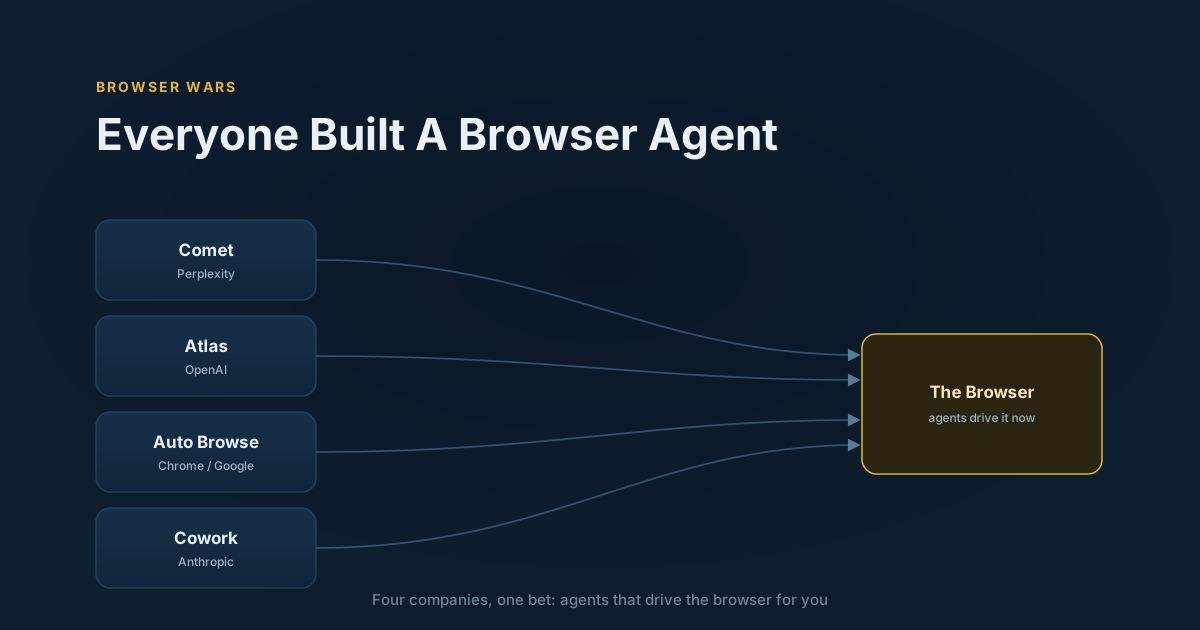
Eighteen months ago, "an AI agent that uses your browser" was a research demo. As of this year, it's a shipped product from every major AI lab at once, and one of them just showed up inside the browser three billion people already have installed.
This post is a status check: what actually launched in 2026, what these products have in common under the hood, and — more usefully — where they still fall down.
The Four Ships That Sailed
| Product | Company | Shipped | What it does |
|---|---|---|---|
| Comet | Perplexity | Desktop July 2025 → Android Nov 2025 → iOS March 2026 | A standalone AI browser with an agent that navigates, compares, and completes tasks across tabs |
| Atlas | OpenAI | October 2025, with Agent Mode | A dedicated browser product where Agent Mode executes multi-step tasks autonomously — the flight-comparison demo is the one everyone's seen |
| Chrome auto browse | January 28, 2026 | Gemini 3 wired directly into Chrome, turning the browser itself into an agent that can scroll, click, type, and navigate on your behalf | |
| Claude Cowork | Anthropic | March 23, 2026 | Desktop control — Claude operating applications and the browser together, not just a browser-only agent |
Perplexity raised roughly $200M at close to a $20B valuation in June 2026, largely on the strength of Comet's rollout. Google's move is the one with the widest blast radius on paper: Chrome's user base dwarfs every dedicated AI browser combined, so "auto browse" is the largest single deployment of agentic browser technology that has ever shipped, by a wide margin — even if most of those three billion users haven't touched the feature yet.
The Data Backs Up the Vibe Shift
It's not just launch announcements. Human Security's April 2026 State of Agentic Traffic report found that browser-based agents — led by Comet and Atlas — account for roughly 71% of observed agentic activity across the top agents it tracks. Agentic browsers specifically generate close to three-quarters of all agentic traffic.
Something genuinely shifted in Q1 2026: these stopped being demos in keynote videos and started showing up in actual change-management memos at companies deciding whether to let an agent touch a real browser session.
Under the Hood, It's the Same Loop
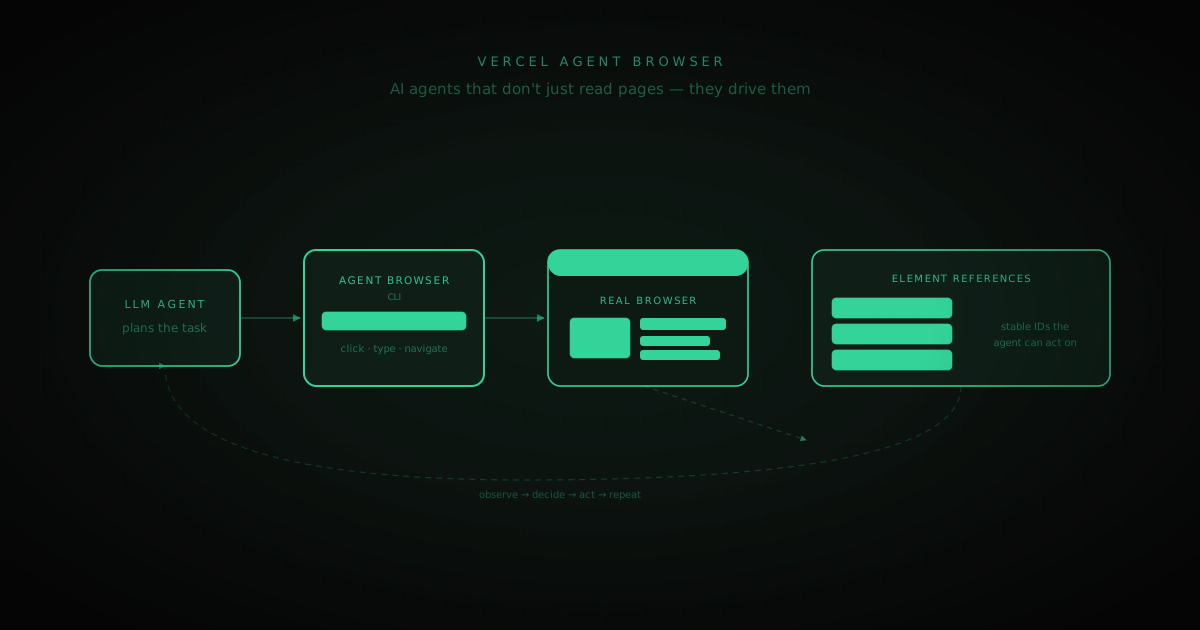
Different branding, same architecture. Strip away the product names and all four are running a version of the loop that Vercel's Agent Browser made explicit months earlier: look at the page, decide what to do, act, look again.
What varies between products is how the page gets described back to the model (raw DOM vs. screenshot vs. an annotated screenshot with numbered element references), how much autonomy the loop is given before it has to check in with a human, and how deeply it's wired into the rest of the product (Cowork spans desktop apps, not just the browser; Atlas and Comet are browser-first).
What's Actually New Here
The meaningful shift isn't "AI can look at a webpage" — that's been true since GPT-4 got vision. It's that these agents drive a real, logged-in browser session, not a sanitized fetch of a page's HTML. That means:
- JavaScript-rendered content that a simple HTTP request would never see
- Your actual logged-in state — the agent can act as you, inside accounts you're already signed into
- Dynamic UI — modals, infinite scroll, multi-step flows — the same way a human would encounter them
That's also exactly why the honest limits below aren't minor.
The Honest Limits Nobody's Advertising
Non-determinism is a feature and a liability. The same task, run twice, can take a different path or a different number of steps. For "book me a flight," that's usually fine. For anything where you need the exact same result every time, it's a real problem — see AI agents vs. web scrapers for the actual cost and accuracy math on that tradeoff.
Letting an agent act inside your logged-in session is a real security surface, not a hypothetical one. An agent that can read a page and then act on what it read is exposed to indirect prompt injection — hidden instructions embedded in page content, designed to hijack the agent into taking an action the user never asked for (submitting a form, navigating somewhere it shouldn't, exfiltrating something visible on screen). This is an active, unsolved area of security research, not a solved problem shipped alongside these launches. Anyone deploying agent-driven browsing at scale, especially inside authenticated sessions, needs guardrails: action approvals for anything destructive or irreversible, scoped permissions, and a hard cap on autonomous steps.
The sites these agents visit haven't stopped fighting back. Bot detection, CAPTCHAs, and rate limits don't recognize "but a frontier lab built this agent" as a reason to stand down. An agent that's smarter about how it clicks still runs into the same walls a scraper does — being capable doesn't mean being welcome.
Cost and latency scale with the loop, not the task's apparent simplicity. Every observe-decide-act cycle is a screenshot in, a model call out. A ten-step task is ten round trips minimum. For anything long-running, token optimization and context engineering stop being nice-to-haves and start being the difference between a usable product and a slow, expensive one.
Where This Leaves Deterministic Extraction
People building in this space keep asking a version of the same question: does a general-purpose browsing agent make purpose-built extraction tools obsolete?
No, for the same reason a general contractor doesn't make a plumber obsolete. Agentic browsers are for open-ended tasks — navigate, decide, adapt, complete something that requires judgment along the way. You pay for that flexibility in tokens, latency, and non-determinism.
When you already know exactly what data you want off a page — a product grid, a listings page, a set of profile fields — you don't need a model reasoning about which element to click. You need something fast, repeatable, and cheap that returns the same rows every time. That's a different job, and it's the one CrawlPilot is built for: point-and-click extraction that runs deterministically in your own browser, with no model in the loop for the extraction step itself.
In practice, the two are complementary rather than competing. An agent might be the right tool to reach a page buried behind a multi-step flow; a deterministic extractor is what you reach for once you're there and just need the data, the same way, every time.
What to Watch Next
Three things worth tracking through the rest of 2026:
- 02Whether Chrome's distribution actually converts to usage. Being installed on three billion devices and being used as an agent are different numbers, and the gap between them is the real story.
- 04How sites respond defensively. If agentic browsing traffic keeps growing, expect more sites to start treating "agent" as its own traffic category to throttle or block outright — Cloudflare already started doing exactly that in July.
- 06Whether the prompt-injection problem gets a real fix or just better guardrails. Right now it's the latter. A genuine fix would be the thing that finally makes autonomous agent browsing safe to point at arbitrary, untrusted pages — and nobody has shipped one yet.
The browser stopped being just a way to read the web. Whether that's a good trade depends entirely on what you're using it for.