The State of AI Coding Agents in 2026: What the Adoption Data Actually Shows
86% of enterprises now run AI coding agents in production, not pilots. Here's what the 2026 adoption, productivity, and spend data actually shows.

"Developers are experimenting with AI coding tools" stopped being an accurate sentence sometime in the last year. The 2026 data describes something closer to standard infrastructure: most enterprise software shipped this year touches an agent somewhere in its production or its build process, and the organizational structure around that shift — budgets, ownership, pricing models — has moved just as fast as the tooling.
Here's what the numbers actually say, separated from the vendor-survey noise that inevitably surrounds a hot category.
The Market, in Scale
The enterprise AI coding agent market is running at roughly $9.8-11.0 billion annualized as of April 2026. Zoom out further and IDC and McKinsey converge on a striking number: roughly $1.4 trillion in global enterprise AI agent spend by 2027 — coding agents are one slice of a much larger category, but currently the most mature one.
The spend growth inside individual companies is just as steep: the median enterprise's monthly LLM bill grew 7.2x year-over-year entering Q1 2026. That's not a rounding-error budget line anymore — it's a cost center serious enough that finance teams are paying close attention to it, which shows up later in this post as a pricing-model shift.
From Pilot to Production
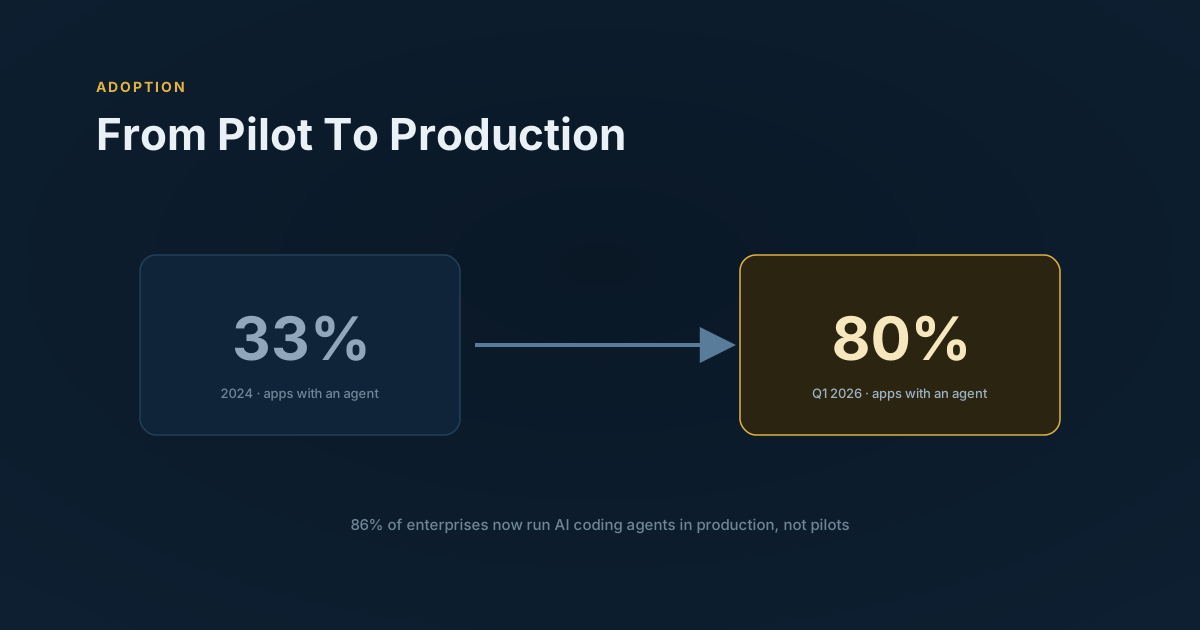
80% of enterprise applications shipped or updated in Q1 2026 embed at least one AI agent, up from 33% in 2024. That's the headline shift: two years ago, an agent in your application was a differentiator. Now its absence is closer to the exception.
On the coding-agent question specifically: 86% of enterprises have moved beyond experimentation into production use of AI coding agents — not "we ran a pilot," but "this is how code gets shipped now." Enterprises are ahead of smaller companies here (91% vs. 83% for SMBs), likely reflecting both budget and the internal platform teams needed to operationalize agent tooling safely at scale.
The Developer-Level Numbers
- 84% of developers say they use or plan to use AI tools in their development process.
- 51% of professional developers report using AI tools daily — a majority, not an early-adopter minority.
- Developers report saving roughly 3.6 hours per week using AI coding tools.
- 90% of engineering leaders report productivity improvements, with a net average productivity gain of 19.3%.
That last figure deserves a grain of salt that most coverage skips: it's a self-reported, survey-level number, not a controlled measurement. Self-reported productivity gains tend to run optimistic — people notice the fast wins (autocomplete, boilerplate, quick refactors) more than the time spent reviewing, correcting, or re-prompting when an agent gets something subtly wrong. The 3.6-hours-per-week figure is a more concrete, harder-to-fudge number worth weighting more heavily than the percentage.
The ROI Timeline Is Real, and Uneven
Median time-to-value on agent deployments is 5.1 months — meaningful, but not instant, and worth setting expectations against if your organization is budgeting a quarter for payback. It varies significantly by use case: SDR (sales development) agents pay back in about 3.4 months, while finance and operations agents take closer to 8.9 months — a sensible pattern, since sales workflows tend to be simpler, higher-volume, and more forgiving of occasional errors than finance workflows, where mistakes are more costly and review overhead is higher.
If you're evaluating where to deploy agent tooling first inside your own organization, that gap is a useful prior: start where task volume is high and the cost of an individual error is low, not where the dollar value per task is highest.
The Pricing Model Is Shifting Under Everyone's Feet
A structural change worth flagging separately from the adoption numbers: vendors are moving from seat-based subscriptions to usage-based pricing, reflecting the actual compute cost of agentic workflows — an agent that takes twenty tool-calling steps to complete a task costs meaningfully more to run than one that answers in a single completion, and seat-based pricing was never built to capture that difference.
For buyers, this is a real budgeting problem, not just a vendor detail: a fixed per-seat cost is predictable; usage-based cost tied to how aggressively your teams actually use agentic workflows is not, at least not until you have a few billing cycles of data. Anyone rolling out agent tooling broadly should expect this transition and budget with real usage headroom, not last year's per-seat math.
The Competitive Shift Nobody Predicted a Year Ago
Frontier model providers are now competing directly with application-layer vendors — not just on raw code generation quality, but on their ability to coordinate complex, multi-step workflows and integrate across engineering environments. That's a meaningfully different competition than "whose model writes better code," and it's squeezing application-layer companies that built a business purely on top of someone else's model, without a defensible workflow or integration layer of their own.
The Org Chart Is Catching Up
56% of enterprises now name a dedicated "AI agent owner" or "agentic ops" lead, up from just 11% in 2024. That's a fast organizational shift, and a telling one: companies have stopped treating agent tooling as something individual teams adopt ad hoc, and started treating it as infrastructure that needs an accountable owner — the same trajectory cloud infrastructure and security both went through a decade earlier.
Reading the Numbers Honestly
The real signal in this data isn't "AI coding agents are impressive" — that part's been true for a while. It's that the operational maturity around them caught up fast: production deployment rates, dedicated ownership roles, and usage-based pricing are all signs of a category that stopped being experimental and started being budgeted, staffed, and governed like any other core piece of engineering infrastructure.
The honest caveat that applies across all of it: adoption statistics measure whether a tool got deployed, not whether it's being used well. "86% run agents in production" is a real number and a real shift — it's also compatible with a wide range of actual maturity, from teams with real evaluation pipelines and guardrails to teams that turned on a feature flag and called it done. The gap between those two is where the next two years of this category will actually get decided.