When One Zone Goes Dark: Designing for Zone Failure with Static Stability and Cells
A cloud zone losing power should cost you a third of your servers, not your service. How a zone loss turns into a regional outage, and the designs that stop it: static stability, zone-affine routing, cells, shuffle sharding and retry budgets, with a simulator to try them.

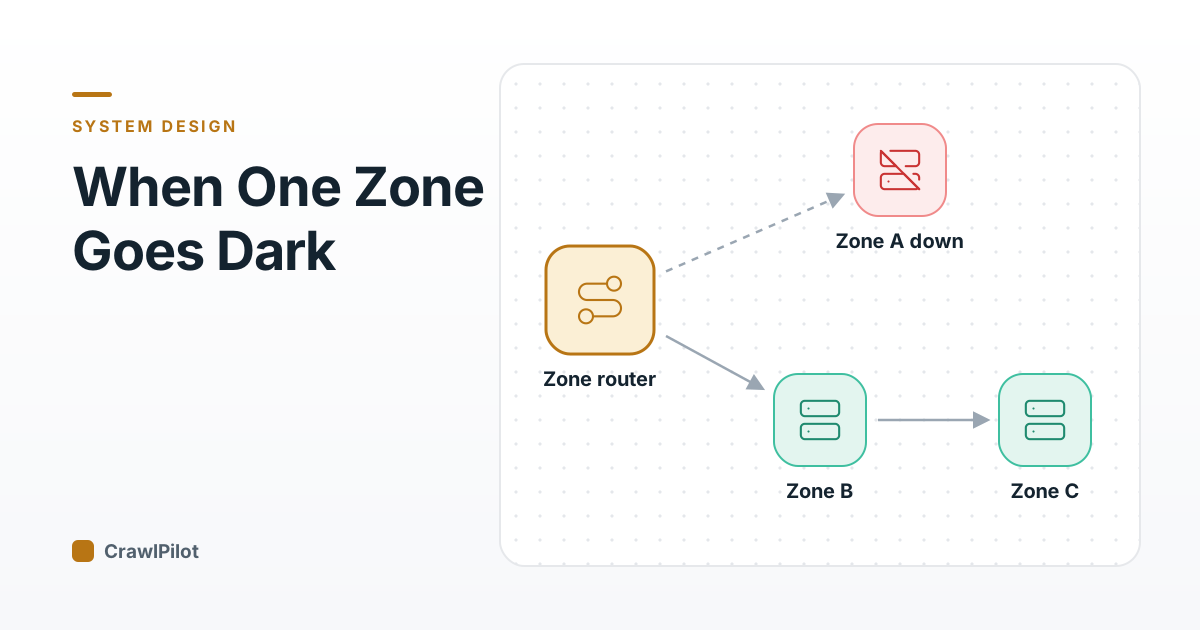
At 06:08 UTC on Tuesday 20 October 2026, Google Cloud services in its London region started failing. Google later attributed it to a "power event" in one zone, europe-west2-b, one of the region's three zones. Through the day the Press Association reported problems for customers of Revolut, Lloyds, HSBC and Halifax, for the video platform the courts in England and Wales use for remote hearings, and for Royal Mail, DPD and Rightmove.
This post is not a diagnosis of that incident. As of 25 October, Google has not published its root-cause analysis; it said it would "publish an analysis of this incident once we have completed our internal investigation." What I can do is explain the general mechanics: why losing one zone so often hurts far more than a third of a system, and the designs that keep it to a third.
What Was Reported on 20 October
Here is the incident as far as reputable reports and Google's own status updates go, and no further:
- Oct 20, 06:08 UTCServices start failing
Downtime begins in Google Cloud's London region; Google later says a power event caused an outage within the europe-west2-b zone.
The Register - Oct 20, daytimeBanks and courts report problems
Revolut customers can't make card payments, transfers or cash withdrawals; Lloyds, HSBC and Halifax customers report app problems; the courts' video platform is disrupted.
PA via Irish News - Oct 20, 11:58 UTCRecovery under way
Google says full recovery should be completed, tentatively, by 13:00 UTC.
The Register - Oct 20, 14:03 UTCMitigated for most customers
Google says the issue is mitigated for most of its customers.
The Register - Pending · pendingGoogle's incident analysis
Promised after its internal investigation; not published as of October 25.
Two details from Google's updates matter for the rest of this post. During recovery it said it was "prioritizing the recovery of existing workloads" and that "customers may not be able to yet create new workloads" (The Register). In other words, the ability to launch new capacity was itself limited while the zone recovered. Reports also differ on exact times: AFP reported Google saying most services were back to normal by 12:10 GMT, while PA reported Google saying at 3pm UK time that most issues were resolved, with a very small number of customers still affected. Which customers lost what, and why, will only be clear when the analysis lands.
Zones Are a Promise About Correlated Failure
A region is a geographic area; a zone is a deployment area inside it. Google's documentation says it "designs zones to minimize the risk of correlated failures caused by physical infrastructure outages" and that "if a zone becomes unavailable, you can transfer traffic to another zone in the same region to keep your services running" (Google Cloud docs). AWS makes the same promise with Availability Zones.
That promise has a precise shape, and it is narrower than people assume. The provider promises that zones are unlikely to fail together. It does not promise that your system survives one failing. That second part is your design: whether the other zones have room for the traffic, whether anything you need lives only in the dark zone, and whether getting back to normal requires an action that can't happen during the incident.
Here is what a three-zone service usually looks like on the whiteboard, and how a zone loss spreads through it.
- Normal day: the load balancer spreads requests across three zones, each about 70% busy.
- Zone B loses power. Until health checks fail it, the load balancer keeps sending it a third of the traffic, and every one of those requests fails.
- Zone B is drained and its third lands on A and C. Each now needs 1.5× its old load: at 70% before, that is 105% of what it has.
- The database primary was in zone B. Writes from the healthy zones fail or hang until a failover finishes, holding threads and connections while they wait.
- The autoscaler asks for more servers. That needs the control plane, the same machinery every other customer in the region is now calling.
- Failed requests come back as retries, multiplying the load on zones that were already over capacity. Now the failure sustains itself.
6 steps. Press Play to walk through them, or click any part of the diagram.
Read the steps again and notice that only step 2 is the power event. Steps 3 to 6 are design choices, and each is a common route from "one zone" to "the region":
- Capacity that was never there. Step 3 is arithmetic. If the survivors weren't sized for 1.5× load, they fall over.
- Shared dependencies pinned to one zone. A single database primary, a config service, a cache cluster or a NAT gateway in the dark zone takes the healthy zones' requests down with it.
- Recovery that needs the control plane. Launching instances, scaling node pools, changing DNS or pushing config are all control-plane actions, and they are exactly what a mass recovery overloads. Google's own updates said new workloads might not be creatable during recovery.
- Retries and failover storms. Every client retrying at once is a thundering herd. Google's SRE book gives the arithmetic: if three layers each make 4 attempts, "a single user action may create 64 attempts (4^3) on the database" (Site Reliability Engineering, ch. 22). The same chapter describes a cluster failing, its traffic moving to a neighbour at capacity, and the neighbour then failing too.
Static Stability: Pay for the Failure Before It Happens
The AWS Builders' Library article on static stability (Mike Furr, 2019) gives the cleanest framing I know: "In a statically stable design, the overall system keeps working even when a dependency becomes impaired." The service already has what it needs to ride out the failure, so it can "continue operating correctly without having to launch any new EC2 instances." The load-balanced example in the article "requires no action" during an AZ impairment: failing instances drop out of rotation and the rest absorb the traffic.
The same article separates two kinds of machinery. The control plane is "the machinery involved in making changes to a system": launching, scaling, configuring. The data plane does the ongoing work: serving requests. The best practice it gives is to "separate systems along the control and data plane boundary", and make sure the data plane can keep serving with the control plane down.
Here is the same zone loss on a statically stable design:
- Zone B goes dark. Health checks fail it quickly, and requests that hit it fail fast with a short timeout instead of hanging.
- A and C take B's third with servers that were already running. They were sized for this, so they reach 90% busy, not 105%.
- The data already had a synchronous copy outside zone B. It takes over without a new machine being built or a snapshot restored.
- Scaling back up to normal headroom can wait. Nothing in steps 1 to 3 needed a control-plane call, so its slowness during the incident doesn't matter.
4 steps. Press Play to walk through them, or click any part of the diagram.
What changed is mostly money and discipline, not technology. The capacity was bought in advance, the data was replicated before the failure, and nothing on the serving path needed a control-plane call.
- Cheaper on a normal day: you run near your real load
- Autoscaling handles slow growth well
- Recovery needs launches, scaling and DNS changes during the incident
- Competes with every other tenant for the same control plane
- The gap between failure and new capacity is an outage
- Survivors absorb the load with servers already running
- Nothing on the recovery path calls the control plane
- Easy to test: switch a zone off and watch
- You pay for idle headroom every day
- Every shared dependency also has to be pre-placed outside each zone
Verdict: For anything customers pay through, buy the headroom. Use reactive scaling for growth, not for surviving a zone loss.
The 67% Ceiling, and Why You Should Run Below It
The arithmetic is short. With Z equal zones carrying load L, each zone carries L/Z. Lose one and each survivor carries L/(Z−1). For every survivor to stay at or under 100% at peak, normal utilisation per zone must be at most (Z−1)/Z:
| Zones | Survivors carry | Max normal utilisation per zone | Headroom to buy |
|---|---|---|---|
| 2 | 2× | 50% | +100% |
| 3 | 1.5× | ~67% | +50% |
| 4 | 1.33× | 75% | +33% |
The three-zone row matches the AWS article: "when we use three Availability Zones, we overprovision by 50 percent" (Builders' Library).
The ceiling is the most you can get away with, not a target. Real zones aren't equal, load balancers don't split perfectly, and a failure arrives with a burst of retries on top. In the simulator below, static stability pre-provisions to 60% per zone (illustrative) so the survivors land near 90%, not exactly at the cliff.
Try it. Each tick is one moment of the incident; all numbers are illustrative:
- 01Leave the defaults (70% busy, every defence off) and press Fail zone B. Watch it fail at the front door, then the cross-zone calls fail, then the survivors go past 100% while the autoscaler waits.
- 02Press Reset, turn on static stability only, and fail B again. The capacity is there, yet errors stay high: the retries from the first ticks keep the survivors overloaded.
- 03Add the retry budget. Then add zone-affine routing and see the failure shrink to the dark zone's own requests for a couple of ticks.
- 04Drag utilisation to 65% and 70% with static stability off and watch the "Survives losing one zone?" tile flip.
Steady state. Each zone serves a third of the traffic at 70% busy. Fail a zone to see who picks up its share.
Illustrative model: 3,000 req/s, 150 req/s per server, 2 ticks to detect a dark zone, 5 ticks of stale cross-zone calls, autoscaling after 6 ticks. Server colours: blue running, amber pre-provisioned, teal autoscaled.
Step 2 is worth stopping on. Capacity alone didn't save the system, because the overload was being sustained by its own retries. Bronson et al. call this a metastable failure: "a bad state that persists even when the trigger is removed", kept alive by a sustaining effect, and request retries are the first example they give. They also note that "many production systems choose to run in the vulnerable state all the time because it has much higher efficiency than the stable state." Static stability is the decision not to.
Keeping a Failure Inside One Box
Headroom answers "can we absorb the loss?" Isolation answers a different question: how much of the system does one failure touch in the first place? There are three tools, and they work at different scales.
Zone-affine routing. Once a request enters zone A, every downstream call it makes stays in zone A: the API calls the zone-A instance of the pricing service, which reads the zone-A cache and the zone-A replica. A dark zone B then fails only the requests that were already in B, instead of a third of every request's downstream calls everywhere. It also saves cross-zone latency and data-transfer cost on a normal day. The cost is that each zone needs a complete, balanced stack, and writes still need one leader somewhere, so the database is where affinity ends and replication takes over.
Cells. Zones protect you from the provider's failures. Most outages are your own: a bad deploy, a configuration push, one customer's request that crashes the parser. AWS's whitepaper Reducing the Scope of Impact with Cell-Based Architecture defines a cell as one of "multiple isolated instances of a workload": each cell "is independent, does not share state with other cells, and handles a subset of the overall workload requests." A cell router, "the thinnest possible layer", sends each request to its cell by a partition key such as customer ID. The whitepaper's arithmetic: with 10 cells serving 100 requests, a failure in one leaves 90% unaffected. It names exactly the failures zones can't contain: "unsuccessful code deployments" and "poison pill requests".
- Every request carries a customer ID. The router's only job is to look up which cell owns that customer.
- Each cell is a complete copy of the service with its own data, serving about a third of customers. Cells share no state and make no calls to each other.
- A deploy goes to cell 3 first. It has a bug; cell 3's error rate jumps, the pipeline halts, and cells 1 and 2 never see the bad build.
- Separately, one customer sends a request that crashes the parser. Retries bring it back to the same cell, so the crash loop stays in cell 2.
- Two bad events, and each time two thirds of customers never noticed. Cell 1 saw neither. With more cells, the share affected per event shrinks.
5 steps. Press Play to walk through them, or click any part of the diagram.
The router is the one shared component, which is why the whitepaper insists it stays thin: no business logic, a mapping it can serve from memory, and no dependency on the control plane that moves customers between cells. A router that calls a database on every request has rebuilt the single point of failure the cells were meant to remove.
- Simplest to build and operate
- Best bin-packing and utilisation
- No partition key or router to design
- Every deploy and every poison request can reach every customer
- Scaling limits are found in production, at full size
- A bad deploy or poison request hits one cell's customers
- Each cell has a known, tested maximum size
- Deploys roll out cell by cell
- Needs a partition key that matches how the work divides
- Cross-cell features (search across all customers) get harder
- More copies of everything to watch
Verdict: Start with one fleet; move to cells once one bad deploy reaching everyone is a risk you won't accept.
Shuffle sharding sharpens cells when a cell is a set of shared workers rather than a full copy. The Builders' Library article on workload isolation using shuffle sharding works through eight workers. Plain sharding into four pairs means one bad customer takes out a quarter of everyone. Giving each customer a random pair instead yields 28 possible pairs: "the scope of impact due to a problem is just 1/28th. That's 7 times better than regular sharding." Two customers rarely share both workers, so when one customer's traffic kills its pair, almost every other customer still has one healthy worker. The article's Route 53 example assigns each domain four of 2,048 virtual name servers, giving "a staggering 730 billion possible shuffle shards."
Retries Are the Accelerant
A retry is a bet that the failure was transient. During a zone loss it usually isn't, and every client places the same bet at the same moment. Marc Brooker's Builders' Library article on timeouts, retries and backoff gives the worst case: a five-deep call stack retrying three times at each layer increases database load "243x, making it unlikely to ever recover."
The fixes are old and cheap, which makes skipping them hard to excuse:
- Retry at one layer only, usually the one closest to the user, and fail fast everywhere below it.
- A retry budget. Google's SRE book uses a "per-request retry budget of up to three attempts" plus a per-client budget: a request "will only be retried as long as this ratio is below 10%" (SRE book, ch. 21). In the worst case retries alone push volume to "just below 3X"; the per-client budget holds it to about 1.1×. Brooker's article reaches the same place with a local token bucket for retries. An LLM gateway caps its failovers per request for the same reason.
- Exponential backoff with jitter, so the retries that do happen don't arrive as one synchronised wave.
- Load shedding at the front door. When a zone is at capacity, rejecting the excess quickly with a clear error keeps goodput at capacity. Accepting everything and timing out drags goodput toward zero, which is the collapse you saw in the simulator.
The rate limiter post covers the token-bucket mechanics a retry budget uses.
The Defences as One Stack
None of these defences is enough alone; the simulator showed static stability failing without a retry budget. Treat them as a stack in which every layer has to hold. Switch one off to see the failure it was there to stop:
The zone loss stays a zone loss. Users in the healthy zones never notice; the dark zone's own requests fail fast and are retried once, within budget.
- Pre-provisioned headroomhandled
Without it: The survivors need 1.5× their load and don't have it; they overload while waiting for new servers. Defence: run each of three zones at or below ~60–67% at peak.
- Fast zone health checkshandled
Without it: The load balancer keeps sending a third of traffic into the dark zone, and those requests hang until they time out. Defence: short timeouts and zone-level health checks that drain quickly.
- No single-zone dependencieshandled
Without it: The database primary, config service or cache lives only in the dark zone and takes the healthy zones down with it. Defence: synchronous standbys and replicas in every zone.
- Data plane without the control planehandled
Without it: Recovery needs launches, scaling or config pushes from a control plane that is overloaded by everyone's recovery. Defence: static stability: serve from what is already running.
- Zone-affine routinghandled
Without it: Requests in healthy zones still call services in the dark zone and fail on the downstream hop. Defence: keep each request's calls inside the zone it entered.
- Retry budget and load sheddinghandled
Without it: Every client retries at once and the overload sustains itself after the trigger is gone. Defence: retry at one layer, cap retries at ~10%, shed excess at the edge.
Cells aren't in this stack because they answer a different failure. A zone loss hits every cell's zone-B servers at once; cells earn their cost on bad deploys and poison requests, which hit every zone at once.
Multi-Region Is a Separate Decision
After a regional headline, someone will propose going multi-region. Sometimes that's right. But it is a different project with a different price, and it doesn't replace any of the above. Reports on 20 October quoted a Keele University lecturer saying "true resilience requires designing for regional failures through multi-region deployments" (The Register); that holds for failures that really are regional. A single zone going dark, though, is the failure the zone-level design exists for.
Before going multi-region, check three things:
- What is the failure you are paying for? If the outage that hurt you was one zone, a statically stable multi-zone design fixes it at a fraction of the cost.
- Where does the data live? Stateless services move between regions easily. A database that needs one writer either replicates asynchronously (and loses recent writes in a failover) or synchronously (and pays cross-region latency on every write). That choice is the real design work (the fraud detection design weighs it for a feature store written from two regions).
- Will you actually fail over? A second region that has never taken production traffic is a hope, not a plan. If it isn't exercised regularly, assume it won't work when needed.
For most teams the order is: make one region survive a zone loss with no control-plane action, add cells when your own deploys become the bigger risk, and add a second region only when the business needs to survive the loss of the whole region.
Check Yourself
Q1You run four equal zones. To survive losing any one of them at peak, what is the highest normal utilisation each zone can run at?
Q2Your zones run at 60%, so the survivors have room. Yet after the dark zone is drained, errors stay high for minutes. What is the most likely cause?
Q3Which failure does a cell-based architecture contain that spreading across zones does not?
Keep This
How one zone spreads
- Survivors lack capacity for 1.5× load (three zones).
- A shared dependency, such as a DB primary or config service, lives only in the dark zone.
- Recovery needs the control plane, which a mass recovery overloads.
- Retries multiply load; three layers of 4 attempts make 64 attempts.
Static stability
- Keep working when a dependency fails, without changing anything.
- Buy the headroom in advance; launch nothing during the incident.
- Separate the data plane from the control plane.
The N+1 arithmetic
- Max normal utilisation per zone is (Z−1)/Z: 50%, ~67%, 75% for 2, 3 and 4 zones.
- Run below the ceiling to leave room for retries and uneven zones.
Isolation
- Zone-affine routing keeps each request's calls inside one zone.
- Cells contain bad deploys and poison requests; keep the router thin.
- Shuffle sharding: 8 workers in random pairs, 1/28 impact per bad customer.
Retries and overload
- Retry at one layer, with backoff and jitter.
- Cap retries at about 10% of requests (a retry budget).
- Shed excess load fast at the edge instead of timing out.
Multi-region
- A separate decision for regional failures, with its own cost.
- The hard part is the data: async loses writes, sync adds latency.
- An untested second region is a hope, not a plan.
Sources
- The Register, "Google Cloud says a 'power event' caused today's outage", 20 October 2026.
- Press Association via The Irish News, "Google to investigate cloud outage after UK businesses hit by disruption", 20 October 2026.
- AFP via Kuwait Times, "Power outage hits Google Cloud services, disrupting UK banks", 20 October 2026.
- Google Cloud, "Regions and zones".
- Mike Furr, "Static stability using Availability Zones", Amazon Builders' Library.
- AWS, "Reducing the Scope of Impact with Cell-Based Architecture", AWS Well-Architected whitepaper.
- Colm MacCárthaigh, "Workload isolation using shuffle-sharding", Amazon Builders' Library.
- Marc Brooker, "Timeouts, retries, and backoff with jitter", Amazon Builders' Library.
- Google, Site Reliability Engineering, "Handling Overload" and "Addressing Cascading Failures".
- Nathan Bronson, Abutalib Aghayev, Aleksey Charapko and Timothy Zhu, "Metastable Failures in Distributed Systems", HotOS 2021.

