AI Export Controls Explained: Why the US Treats Frontier AI Like a Strategic Asset
How US export controls on AI mirror the nuclear playbook — what changed, why Claude is now partly a geopolitical instrument, and what fragmented global AI access actually means.

This is an opinion piece. It reflects my read of where things are heading, not a neutral survey of all perspectives.
When Google expanded into China in 2006, the logic was simple: ship the product, grow the users, sort out the politics later. When Facebook spread across Southeast Asia and Latin America, same thing. When Twitter became the world's de facto public square, nobody in Washington seriously asked whether that was a national security decision.
The assumption was that technology transcends borders. Access is good. Openness wins.
That assumption is dead.
Something Just Shifted
Anthropic's most capable model isn't available the same way everywhere in the world. That isn't a business call about local languages or data storage laws. It's the result of a policy framework that treats advanced AI the same way the US treats advanced semiconductors: as technology too powerful to export freely.
This didn't arrive out of nowhere. The Chips Act, the Nvidia GPU export bans to China and Russia, the executive orders on AI and national security — these were the first moves. The restrictions on AI models are the next.
The reasoning goes like this: a capable enough AI system can accelerate weapons research, compromise intelligence operations, enable surveillance at scale, and run influence campaigns automatically. The same model that helps a developer write better code could help a state actor synthesise dangerous materials or crack encrypted communications. That makes it dual-use — useful for civilians, dangerous in the wrong hands — which is exactly how governments classify things like nuclear technology and advanced military hardware.
That logic isn't entirely wrong. But acting on it has consequences most people aren't talking about.
The Open Internet Era Was a Historical Accident
Here's the thing most people get wrong: the era of frictionless global tech expansion wasn't the natural state of the world. It was a specific window — roughly 1995 to 2020 — where the US government made a deliberate bet: let American tech companies go global, extend American influence, and trust that the downside risk is small.
That bet paid off. Google became the default way most of the world accesses information. AWS became the backbone of the global economy. American software won everywhere.
The government allowed this because a foreign government getting access to Google Search isn't a real threat. Search engines and social networks are powerful commercially, but they're roughly symmetric — anyone can build one. They don't give a military advantage.
A frontier AI model is different. A system that can reason, plan, write code, synthesise scientific knowledge, and persuade people — at a level that exceeds most human experts — isn't symmetric. Military planners call things like that force multipliers. And force multipliers get treated like strategic assets, not consumer products.
So the "ship globally, iterate later" doctrine was never going to survive contact with AI at this capability level. The only question was when the rules would change.
Where Anthropic Stands
Anthropic is in an uncomfortable position. The company was founded on a genuine belief that AI is dangerous if built carelessly. Their safety research is serious. Their public commitments to responsible development are real.
But good intentions don't protect you from being co-opted by bigger forces.
When the US government decides frontier AI is a strategic national asset, the companies building it don't get to opt out of that designation. Anthropic has major investment from Amazon and Google. It has government contracts. Whether its founders intended it or not, it exists inside American strategic infrastructure.
The result: Claude — a model explicitly designed to be helpful, harmless, and honest — is now partly a geopolitical instrument. The restrictions on where it can be deployed aren't purely about safety. They're about maintaining American advantage in a technology competition that every major government now treats as existential.
This isn't a conspiracy. It's just how strategic technology has always worked. The same thing happened to radar, to nuclear technology, to GPS, to cryptography. The US doesn't let its most powerful tools freely reach potential adversaries. AI has now crossed into that category.
The World Is Already Splitting
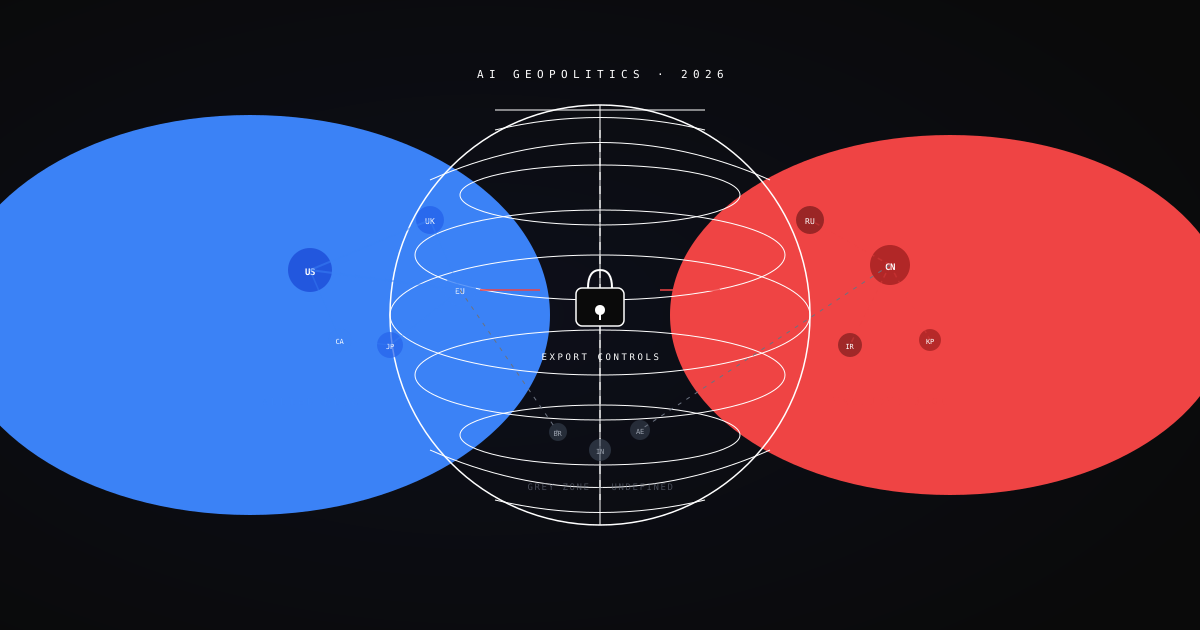
The consequence of this policy shift is that AI is fracturing into geopolitical blocs. And it's already happening.
China has its own frontier models, developed under state direction, not available to American users. Europe is building regulatory frameworks that will effectively require localised model variants. India, the Gulf states, and others are investing in sovereign AI capabilities. The US is tightening controls on what gets exported to whom.
This is not the internet that was promised. The original vision — shared infrastructure, global access, knowledge as a common good — is quietly being replaced by something that looks a lot more like the Cold War's divided world, but with AI models instead of nuclear stockpiles.
The tragedy is that AI's most powerful applications are inherently collaborative. Climate modelling needs global data. Drug discovery accelerates through international research. Language models get better and fairer when they're trained on the full diversity of human language and knowledge. Fragmentation makes all of this harder.
But national security logic doesn't optimise for global benefit. It optimises for relative advantage. When both the US and China are running from that logic simultaneously, fragmentation isn't a risk — it's the destination.
The Problem the AI Safety Movement Doesn't Want to Face
For years, researchers argued: this technology is powerful and potentially dangerous, we need governance, we need oversight. That argument worked. It changed public discourse and drove serious policy attention.
But the governance that emerged isn't primarily safety governance. It's power governance.
The restrictions on Claude's global availability aren't principally designed to prevent misuse by bad actors. They're designed to preserve American strategic advantage. The safety framing got borrowed to serve a different agenda.
The people who built that framing — researchers and founders who genuinely believe in the mission — are now watching their intellectual work repurposed for geopolitical competition.
That doesn't mean safety research was wrong. The risks are real. But it does mean being honest about what "AI governance" actually means once governments get involved. It means control. And control is not the same thing as safety.
What Happens From Here
My read: it gets worse before it gets better.
The US will extend export controls further as models improve. The definition of what counts as "sensitive" AI will keep moving — and it will generally move toward restricting more, not less. Allied countries will get preferential access, creating something like a NATO for AI, with all the internal tensions that implies.
Meanwhile, the excluded countries will build their own. Export controls don't stop technology from existing — they stop it from being shared. China already has capable models. Russia has motivation. Iran has engineers. History shows that every export control regime eventually results in proliferation, because knowledge can't be contained, only delayed.
And the delay only benefits the people who were first — for a while.
Claude was built to be safe. It is now also an instrument of state strategy. Both things are true at the same time. Living with that contradiction is what the next decade of AI development actually looks like.
Is This the New Cold War?
The honest answer is: it looks a lot like one.
The original Cold War was a competition between two superpowers, each racing to build more powerful weapons than the other, while dividing the rest of the world into blocs based on who had access to what technology. The nuclear arms race didn't end because one side won. It stabilised into a tense, expensive standoff where the main deterrent was mutual destruction.
AI is shaping up similarly — except the weapons aren't bombs. They're systems that can think, plan, persuade, and act autonomously, at scale, faster than humans. The race isn't to build more warheads. It's to build more capable models.
The question nobody has answered yet: is there an off-ramp? Can you govern AI in a way that is both genuinely safe and genuinely global? Or are those two things in fundamental tension once frontier AI translates directly into military and intelligence advantage?
The Cold War's version of that question — can you have both security and openness — was never really resolved. It just ended because one side collapsed.
I don't think AI needs to end the same way. But if the US, China, and Europe each retreat into sovereign AI ecosystems that can't interoperate, can't share research, and compete instead of collaborate — the parallel becomes harder to dismiss.
So: is this the new Cold War? Not yet. But the architecture for one is being built right now, one export control and one model restriction at a time. Whether we end up using it is still a choice. For now.