State of Web Scraping 2026: The Market Hit $1.17B — Where the Growth Is Actually Coming From
The web scraping market is growing 13.78% a year toward $2.23B by 2031 — at the exact moment it's getting legally and technically harder. Here's why both are true.

Two things are true about web scraping at the same time in 2026, and they sound like they contradict each other. The market is growing fast — double-digit CAGR, real spending intent, real institutional adoption. And it's getting harder to actually do, on almost every front, at almost the same pace.
Both are true, and the reason why is the actual story — more interesting than either number on its own.
The Headline Numbers
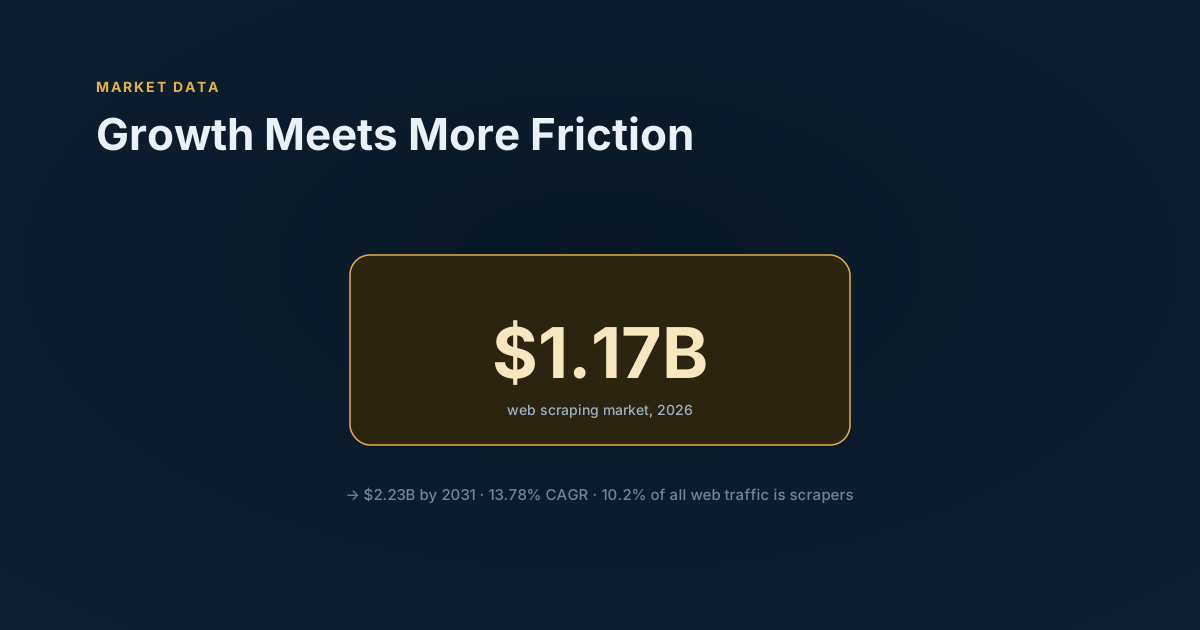
The web scraping market was valued at roughly $1.03B in 2025, is estimated at $1.17B in 2026, and is projected to reach $2.23B by 2031 — a 13.78% compound annual growth rate over that stretch. Separately, industry surveys report that 94% of current users plan to increase spending on scraping infrastructure and services, not hold flat or cut back.
That's not a market in decline looking for a soft landing. It's one accelerating, even as the operating environment around it gets more contested.
Where the Money Actually Is
Growth isn't evenly distributed across industries, and the distribution tells you something about what scraped data is actually for right now:
- Banking, Financial Services, and Insurance (BFSI) held roughly 29.4% of the market in 2025 — the single largest vertical, by a wide margin. Funds, lenders, and insurers feed credit-risk models, trading algorithms, and underwriting systems with scraped news, job-posting data, and consumer sentiment signals. This is not casual data collection; it's core infrastructure for financial decision-making at scale.
- Advertising and Media, while smaller in absolute terms today, is growing fastest — around 15.17% CAGR — as ad-tech and media companies build competitive intelligence and pricing pipelines around scraped data.
- The technical shift happening underneath both: more teams are moving to AI-driven extraction, where you describe what data you want instead of writing and maintaining CSS selectors, and more teams are using cloud-managed browser environments instead of maintaining their own headless browser fleets — outsourcing scaling, session management, and infrastructure overhead to platforms built for exactly that.
The Number That Actually Surprises People
Here's the one worth sitting with: according to F5 Labs' 2026 Advanced Persistent Bot Report, 10.2% of all global web traffic comes from scrapers — even after bot-mitigation systems filter what they catch.
One in ten requests hitting the open web, after the defenses have already done their job, is a scraper. Web scraping isn't a niche technical activity practiced by a small community of developers. It's a massive, mostly invisible layer of internet traffic that most people using the web have no idea is happening around them, constantly.
The Paradox, Explained
So why is a market under mounting legal and technical pressure also the market growing fastest?
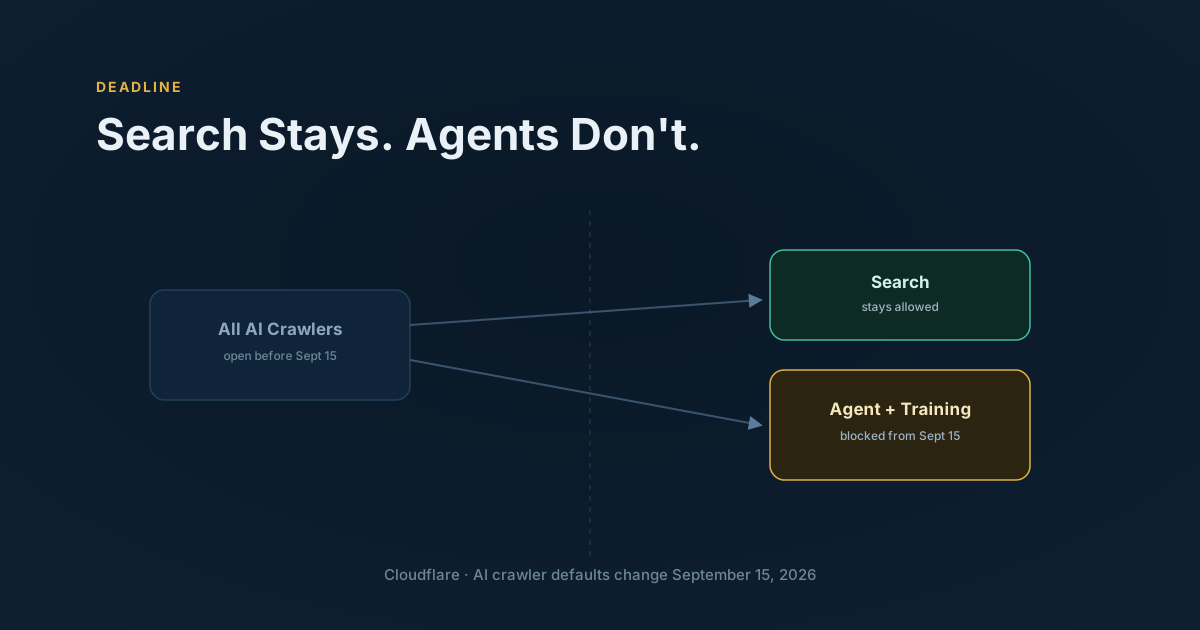
Because the pressure and the growth are coming from the same underlying cause: everyone building anything with AI right now needs structured, reliable, current data, and there's no substitute for the open web as the source of it. The demand didn't slow down when Cloudflare announced it would block Agent and Training crawlers by default starting September 15. The demand didn't slow down when a federal court narrowed one theory about what counts as DMCA circumvention, or when Google sued a SERP-scraping company over the same underlying legal question from the other direction. If anything, the AI boom driving all three of those stories is the same boom driving the market growth number.
What's actually happening is a filtering effect, not a slowdown. Rising friction doesn't reduce demand for data — it changes who can economically meet that demand, and how:
- Well-capitalized players can absorb compliance and licensing costs — paying for Pay Per Use access, negotiating data licensing deals, building the infrastructure to operate within increasingly complex rules. This is expensive, and expense is a moat that favors incumbents.
- Server-side, high-volume, broad crawling — the traffic pattern that looks identical to what an AI lab's training crawler does — is exactly the traffic pattern getting classified, throttled, and blocked by default at the infrastructure layer. That squeeze is real and it's getting tighter, not looser.
- Small-scale, local, human-driven extraction — a single person pulling data through their own authenticated browser session, the way CrawlPilot and tools like it work — sits in a genuinely different traffic category than any of this. It was never the target of Cloudflare's classification system or the AI-training lawsuits, because it isn't shaped like the thing those systems and suits are built to catch.
The middle is where it gets uncomfortable: mid-scale, semi-automated scraping operations that are too big to look like a single human browsing, too small to negotiate a licensing deal, and too broad to avoid the new default-block rules. That segment is the one actually absorbing the pressure from every direction at once — which is a genuinely different situation than "scraping is dying" or "scraping is booming," the two takes that dominate the discourse and are both, individually, wrong.
What to Watch for the Rest of 2026
Whether the Cloudflare defaults actually stick. September 15 is a default, not a mandate — how many site owners actively override it in either direction will say a lot about where the market's center of gravity actually is.
Whether the SerpApi and robots.txt cases produce real appellate precedent, or stay as district-court-level uncertainty that everyone keeps operating around rather than resolving.
Whether AI-driven extraction actually closes the cost gap with traditional selector-based scraping at scale — the technology is trending that direction, but the unit economics still favor deterministic extraction for high-volume, well-structured targets today.
The scraping industry has weathered "this changes everything" moments before — the shift to headless browsers, the rise of sophisticated anti-fingerprinting, the proxy-network consolidation wave. The current moment, with legal, technical, and infrastructural pressure all rising at once alongside genuine demand growth, looks less like an ending and more like a sorting mechanism — deciding which approaches survive at which scale, not whether the underlying activity survives at all.