Agentic Commerce Is Coming for E-commerce: What Google's UCP and OpenAI's ACP Mean for Sellers
AI agents are starting to browse, compare, and buy on shoppers' behalf. Here's what Google's UCP and OpenAI's ACP protocols mean for e-commerce sellers.

For twenty years, e-commerce SEO has optimized for one reader: a person, scrolling, comparing tabs, deciding. That assumption is starting to break. A growing share of shopping research — and increasingly, the purchase itself — is being delegated to an AI agent that never opens a second tab, never gets tempted by a banner ad, and doesn't care about your homepage design.
This isn't a five-years-out prediction. The infrastructure is being built right now, by the two companies with the most leverage to force sellers to adapt to it.
The Two Protocols Doing the Actual Plumbing
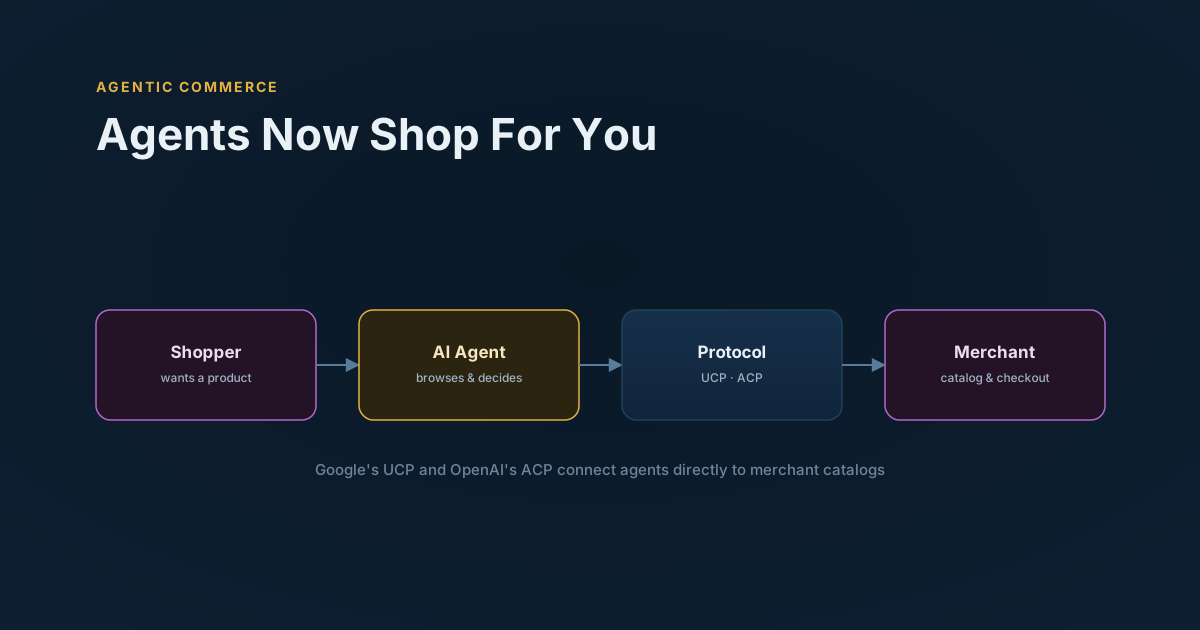
Google's Universal Commerce Protocol (UCP) gives AI agents a standard way to interact with a merchant's catalog, cart, and checkout flow — one integration a merchant builds once, that any UCP-compliant agent can then use, instead of every AI company scraping and reverse-engineering every storefront differently.
OpenAI's Agentic Commerce Protocol (ACP), built jointly with Stripe, does the equivalent job for OpenAI's ecosystem. It already has real merchant partners live on it — Instacart, DoorDash, Shopify, and Etsy are all named integration partners, which means this isn't a speculative spec sitting in a GitHub repo, it's connected to platforms sellers are already using today.
The shape of both is the same: instead of an agent trying to parse your website like a confused human — screenshotting your product grid, guessing which button is "add to cart" — it talks to your catalog through a structured, machine-native interface built for exactly this. That's a meaningfully different integration surface than "make sure your site doesn't break when a headless browser visits it."
The Consumer Behavior Is Already Shifting
This isn't purely a B2B infrastructure story — actual shopping behavior is moving faster than most retailers' roadmaps.
- 73% of consumers already use AI somewhere in their shopping journey today.
- 45% use it for product ideas, 37% for summarizing reviews, 32% for comparing prices.
- The trend line points from recommendation toward execution — agents that don't just suggest a product but complete the purchase, with lighter and lighter human involvement in the loop.
That progression matters because each step removes a page view, a click, and a moment of brand exposure that today's e-commerce funnel is built entirely around.
What Changes for a Seller
The practical shift: your product data has to be correct and structured enough for a machine to transact on, not just readable enough for a human to browse. Price, availability, variant options, shipping terms — if an agent is completing a purchase autonomously, ambiguity that a human would resolve by scrolling or asking customer service becomes a failed transaction or, worse, a wrong one.
That raises the bar on structured data in a very concrete way: Product and Offer schema.org markup, accurate real-time inventory feeds, and clean variant/SKU data stop being a "nice for SEO" checkbox and start being the actual interface your highest-intent, most-automated customers transact through.
The Uncomfortable Part: Attribution Goes Dark
The infrastructure story is exciting; the business-model story is genuinely uncomfortable for anyone who monetizes the browse-and-discover phase of shopping.
When an agent inside ChatGPT or a shopping assistant handles the discovery, comparison, and refinement of preferences, that entire behavioral data stream — the browse, the "actually show me cheaper options," the reviews it read on your behalf — happens inside the AI platform's interface, not on your site. The purchase might still route to your storefront through UCP or ACP, but the attribution, the on-site personalization signal, and the retail media impression that used to happen along the way don't. Discovery moves upstream to a platform you don't control and largely can't instrument.
This is the same structural pattern publishers are living through with AI Overviews cutting organic traffic — the transaction or the click still eventually reaches you, but the surrounding context, the brand impressions, and the data exhaust that used to come with it increasingly don't.
What Sellers Should Actually Do Now
Get your product data machine-transactable, not just machine-readable. There's a difference between a page that renders correctly in a browser and a catalog an agent can reliably transact against without a human resolving ambiguity. Audit for the gap.
Watch which protocol your platform adopts, and don't assume "SEO-ready" means "agent-ready." A product feed that ranks well in Google Shopping isn't automatically well-formed for UCP or ACP — the schemas and integration requirements are different enough that they need their own checklist, not a rebrand of your existing feed.
Accept that some of your funnel visibility is going away, and plan around it rather than fighting it. The sellers who adapt fastest to agentic commerce won't be the ones trying to keep every shopper on-site through the whole journey — they'll be the ones who make sure that whichever protocol the agent is using, their catalog is the accurate, well-structured one it can actually transact against.
The web didn't get less commercial with agentic commerce. It got less visible to the seller in the middle of the transaction — which is a different problem than the one most e-commerce teams are currently staffed to solve.