The EDPB's Draft Web Scraping Guidelines: What They Ask of AI Scrapers, and How to Comment by October 30
The European Data Protection Board's draft Guidelines 03/2026 set out how the GDPR applies to scraping for generative AI: legitimate interest, robots.txt and CAPTCHAs as evidence of expectations, filtering, special-category data and contractor roles. Comments close October 30, 2026.

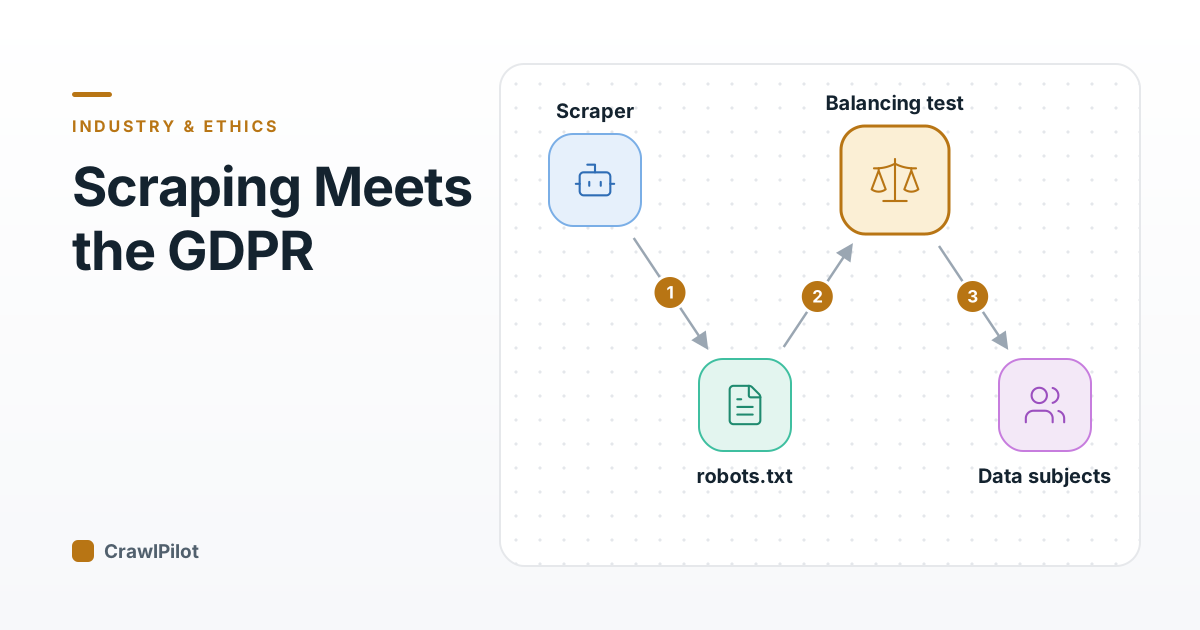
Picture a content-sharing platform that blocks scrapers with robots.txt and a CAPTCHA, and says on its site that its users' data may not be used to build AI models. In the European Data Protection Board's new draft guidelines, that platform is Example 5, and the Board's verdict takes one line: its users "cannot reasonably expect third parties to scrape that data for that purpose" (Guidelines 03/2026, ¶64).
A US court compared robots.txt last December to a keep-off-the-grass sign that doesn't control access (opinion; our write-up). Nothing in the EDPB draft depends on the file being a lock. Its point is about evidence: under the GDPR, the file says something about what the people on that site could expect, so ignoring it can count against the scraper.
What follows is a reading of the draft itself, with paragraph numbers so you can check each point. It isn't legal advice.
- May 25, 2018The GDPR applies
Regulation (EU) 2016/679, adopted on 27 April 2016, starts to apply.
GDPR Art. 99 - Oct 8, 2024Legitimate-interest guidelines
Guidelines 1/2024 on Article 6(1)(f), which the scraping draft cites for the three-part test.
EDPB - Dec 17, 2024Opinion 28/2024 on AI models
The Board's opinion on personal data in AI models, including scraping in development.
EDPB - Jul 7, 2026Guidelines 03/2026 adopted
Version 1.0, adopted for public consultation.
Guidelines (PDF) - Jul 8, 2026Feedback period opensConsultation
- Oct 2026'At a glance' summary published
A short plain-language version with the worked examples.
EDPB (PDF) - Oct 30, 2026 · pendingComments close at 23:59 CETConsultation
- After the consultation · pendingFinal version
Reed Smith expects it no earlier than the end of 2026.
Reed Smith (commentary)
Guidance in Draft, Not a New Law
The EDPB's own description of its work separates the binding decisions it addresses to national authorities in cross-border disputes from "general guidance (including guidelines, recommendations and best practices) to clarify and promote a common understanding" of the law (EDPB). Guidelines 03/2026 are the second kind. They create no new obligations; they say how the Board reads the GDPR's existing ones when the processing is scraping for generative AI. They're also version 1.0, open for comment, so the wording below may change.
The scope is narrow, and it's worth reading before anything else (¶1–6):
- Covered: an organisation that scrapes to train or fine-tune generative AI, itself or through a contractor, and one that reuses a dataset someone else scraped.
- Not covered: data brokers who scrape and hold datasets "whose intention is not to train AI models themselves" (¶4), an organisation's own data (¶5) and public bodies (¶6).
- Still the law anyway: ¶5 adds that leaving a situation out "does not mean that the excluded situations are not subject to data protection legislations."
The GDPR applies when scraping processes personal data, whether it identifies someone directly (names, pictures, contact details) or indirectly (¶12). A "mixed" dataset is still covered for its personal part (¶13).
Six Places the Text Touches a Scraping Pipeline
The draft describes scraping as four steps: defining collection criteria, extraction, cleaning, and structuring and storing (¶11). Its obligations land on each of them, then carry on through training and into what you owe the people in the data. Step through it:
- Before fetching anything: precise criteria, a data map, and excluding sites that structurally hold sensitive data or 'clearly oppose the scraping' with robots.txt, ai.txt, CAPTCHA or authentication (¶37).
- Collection. Untargeted crawling 'increases the risk that the controller has limited knowledge of what personal data are collected' (¶8). Syntax-based filters should run during collection (¶38).
- Clean and store: anonymise or pseudonymise where feasible, timestamp and validate the data, and delete unnecessary personal data 'as soon as possible' (¶38, ¶42, ¶66g).
- Training. Measures against memorisation and regurgitation, such as deduplication, count as safeguards (¶66i). Once a model is trained, personal data 'cannot be easily deleted' from it (¶60).
- If telling each person is impossible or disproportionate, publish a notice with the data categories, purposes, legal basis, sources and the 'crawler's characteristics' (¶30).
- An opt-out list lets people object to collection on given sites, 'including before the data collection occurs' (¶66f). It feeds back into source selection.
6 steps. Press Play to walk through them, or click any part of the diagram.
Step 1 does most of the work. The draft wants the assessment made "before the scraping begins, so as not to collect personal data that is not necessary" (¶36). It also says data minimisation "does not prohibit training an AI model or AI system with large volumes of data." The rule is about which data you take, not how much.
On transparency, the escape hatch in Article 14(5)(b), where notifying each person would take disproportionate effort, is available but "should not be routinely relied upon" outside archiving, research and statistics (¶27). The draft's two examples set the line. A 20-year scrape of forums with no direct identifiers qualifies for a public notice instead (Example 2). A recent scrape of 5,000 named people in a closed group with email addresses does not, and those people should be told one by one (Example 3). Listing domains and URLs in a searchable format, with collection dates, is called good practice (¶31).
Consent Doesn't Work, So Legitimate Interest Has to Be Earned
The draft rules out the basis many people assume first. Consent "would most probably not be an applicable legal basis", because a scraper has no direct relationship with the people in the data and can't ask each of them beforehand (¶44). Publishing something on an open web page isn't consent to having it scraped, and "the absence or non-applicability of a robots.txt file on a web site does not amount to consent" (¶45).
- No direct relationship with the people scraped (¶44)
- A public post is not consent to scraping (¶45)
- A missing robots.txt is not consent either (¶45)
- Each person agrees before collection
- Does not need every person's prior agreement
- Three cumulative conditions (¶47)
- Fails if people's interests override and safeguards fall short (¶65)
- 'Often relied on' by private bodies for generative AI (¶43)
Verdict: Consent is out in practice; legitimate interest is the realistic route, and only if you pass all three conditions.
The three conditions come from the Board's 2024 guidelines on legitimate interest and are cumulative (¶47): a legitimate interest, necessity, and a balancing test that the person's rights don't override. The balancing test splits into several factors in the draft (¶53–64), and the safeguards in ¶66 are what can tip it back. Turn any of them off and see where the assessment stops:
Legitimate interest can hold. All three conditions are met and the safeguards are in place. The draft still calls the choice of measures a case-by-case assessment (¶66).
- 1. A legitimate interesthandled
What the draft asks: An interest that is lawful, 'clearly and precisely articulated' and 'real and present, not speculative' (¶49). How the draft says to meet it: for a general-purpose model, state the objective: commercial, public or research, internal or external (¶50).
- 2. Necessityhandled
What the draft asks: Whether the processing achieves the purpose and whether an 'equally effective and less intrusive way' exists (¶51). How the draft says to meet it: narrow the collection criteria rather than scraping 'a wide part of the internet', and consider pseudonymised or synthetic data (¶52).
- 3a. Balancing: nature of the datahandled
What the draft asks: The more sensitive or private the data, the more weight it carries (¶56). Location, financial and children's data are named (¶55). How the draft says to meet it: exclude certain data categories, and sources sensitive by subject matter, by default (¶66b).
- 3b. Balancing: reasonable expectationshandled
What the draft asks: Whether people could expect this scraping, given the source, how public the data is and the site's restrictions (¶64). How the draft says to meet it: skip sites that oppose scraping with robots.txt, ai.txt, CAPTCHA or authentication, and data only visible after login (¶37, ¶66c).
- 3c. Balancing: consequences and rightshandled
What the draft asks: How hard it is for people to object, and that personal data 'cannot be easily deleted from a model' once trained (¶60). How the draft says to meet it: an opt-out list usable before collection, a published list of scraped sites, and early deletion or anonymisation (¶66e–g).
- 3d. Balancing: downstream misusehandled
What the draft asks: Memorisation, regurgitation and attacks on the model. Example 6 denies legitimate interest to a voice-generation tool with no such protection. How the draft says to meet it: deduplication and other measures limiting memorisation and regurgitation (¶66i).
The draft also gives the passing case. Example 7 is a text model trained only on freely accessible data that people manifestly made public, excluding copyrighted content unless it's public domain or its rights holders haven't opted out of text and data mining, with anti-memorisation safeguards, rights handling and sources named in a public privacy policy. For that one, "the balancing test may generally be considered as met." It covers most of the switches above: data people made public themselves, rights handling, anti-memorisation safeguards and published sources.
robots.txt, CAPTCHAs and Login Walls as Privacy Evidence
This is the section scrapers will quote most, so it's worth being exact about what the text says. Signals show up in two places.
- ¶37, data minimisation: before collecting, exclude "websites which clearly oppose the scraping of their content, through the use of technical measures", naming authentication to view content,
robots.txtorai.txtfiles, and CAPTCHAs. - ¶64, reasonable expectations: among the things a controller "should consider" are "the restrictions imposed by the scraped website", with the same measures as examples. Then: "If data subjects are aware that a website implements these measures and a website is nevertheless scraped, it is less likely that they can expect the processing of their personal data by a scraping entity."
Two details are easy to miss. The ¶64 sentence is conditional on people being aware of the measures, and expectations are only one factor in the balancing test (¶53, ¶62). Paragraph 63 adds that publishing a privacy notice doesn't, by itself, make processing expected. Reed Smith's commentary reads this more broadly: "Ignoring robots.txt or circumventing access controls now carries direct GDPR consequences for the balancing test" (Reed Smith). That's a fair summary of where the text points, though the text itself stays at "less likely".
Combine the signals yourself. Each switch shows the paragraph behind it:
The source site
How the draft reads it
Not settled by signals alone.
¶64: people 'may be aware' that what they publish can be reused, but cannot be assumed to expect it 'in all situations, for all purposes'. The nature of the source and of the people concerned still count.
- ¶64: The 'rule of thumb': data the person made public to everyone is more likely to be expected to be processed by others.
Switching everything off is not permission: the absence of a robots.txt file "does not amount to consent" (¶45), and expectations are one factor in the balancing test, not the whole test (¶53, ¶62).
Logged-in scraping gets its own line. Among the mitigating measures, ¶66(c) lists excluding personal data "only accessible when logged into the site", and data on freely accessible sites where people can't be considered aware of it: for instance where a social network returns more to the scraper's user agent (timestamps, access statistics) than to a normal user.
Since robots.txt is now part of the evidence, it helps to know what yours, or your target's, actually says. Here is a sample for a community forum that wants search engines but no training crawlers; edit it or try other paths:
Paste any site's file from https://its-domain/robots.txt. It's checked in your browser; nothing is fetched or sent.
- BlockedGPTBotOpenAITrainingLine 7: Disallow: / (its own group)
Crawls content that may be used to train OpenAI's models. Docs
- AllowedOAI-SearchBotOpenAISearchLine 12: Allow: / (the * group)
Decides whether your pages can appear in ChatGPT search. Docs
- AllowedChatGPT-UserOpenAIUser fetchLine 12: Allow: / (the * group)
Fetches pages when a ChatGPT user asks; OpenAI says robots.txt rules may not apply. Docs
- BlockedClaudeBotAnthropicTrainingLine 7: Disallow: / (its own group)
Collects content that may be used for model training. Docs
- AllowedClaude-SearchBotAnthropicSearchLine 12: Allow: / (the * group)
Indexes content for Claude's search results. Docs
- AllowedClaude-UserAnthropicUser fetchLine 12: Allow: / (the * group)
Fetches pages when a Claude user asks. Docs
- BlockedGoogle-ExtendedGoogleTrainingLine 7: Disallow: / (its own group)
Controls use for Gemini training and grounding; doesn't affect Google Search. Docs
- AllowedApplebot-ExtendedAppleTrainingLine 12: Allow: / (the * group)
Controls use of Applebot's crawl for Apple's generative AI training; it doesn't crawl. Docs
- AllowedPerplexityBotPerplexitySearchLine 12: Allow: / (the * group)
Surfaces and links sites in Perplexity's search results. Docs
- AllowedPerplexity-UserPerplexityUser fetchLine 12: Allow: / (the * group)
Fetches pages a user asks for; Perplexity says it generally ignores robots.txt. Docs
- BlockedMeta-ExternalAgentMetaTrainingLine 7: Disallow: / (its own group)
Crawls for uses such as training AI models or indexing content. Docs
- AllowedMeta-ExternalFetcherMetaUser fetchLine 12: Allow: / (the * group)
Fetches links a user asks for; Meta says it may bypass robots.txt. Docs
- BlockedCCBotCommon CrawlTrainingLine 7: Disallow: / (its own group)
Builds Common Crawl's open web corpus, widely used to train models. Docs
Filtering Before You Fetch, and the Special-Category Problem
Paragraph 37 is the closest thing in the draft to a build spec. Before collection: consider synthetic data, define precise criteria, map and inventory the data, filter out unneeded categories such as bank transactions or geolocation, skip site categories that structurally hold sensitive data (the example is sites "used mainly by minors"), and skip sites that oppose scraping. During and after (¶38): syntax-based filters such as regular expressions for things like social security and phone numbers, synthetic replacement where feasible, and anonymisation or pseudonymisation. Accuracy adds three more (¶42): prefer reliable, maintained sources over "secondary or outdated aggregators", timestamp what you scrape, and validate before training.
Special categories (health, ethnic origin, political opinions, sexual orientation and the rest of Article 9) are prohibited without a derogation in Article 9(2) on top of an Article 6 basis (¶67). The draft is candid that a scraper usually can't know whether it collected any until after the fact (¶68). Its answer borrows from the CJEU's GC & Others ruling on search engines, C-136/17, where the prohibition applied "within the framework of [the operator's] responsibilities, powers and capabilities" (¶70). The Board says that reasoning "can be relevant" for incidental and residual collection when scraping to train AI, and "should not be seen as a general exemption" (¶72). It holds only if you take measures at four stages:
- Define precise criteria and apply filters to prevent collecting special-category data; exclude site categories that structurally contain it (¶74 i).
- Delete what got through immediately after collection or as soon as it's identified, including on a person's request that plausibly shows the data is covered (¶74 ii).
- During development, prevent extraction from the model, provide assurance on resistance to privacy attacks, test, and add output filters (¶74 iii).
- After deployment, monitor outputs constantly and act at once if special-category data appears. Machine unlearning is mentioned for the longer term (¶74 iv).
4 steps. Press Play to walk through them, or click any part of the diagram.
The controller also has to be able to show that the conditions apply and that its measures work (¶75), and keep checking them against the state of the art (¶76–77).
Who Is the Controller When You Scrape for Someone Else
If you run scraping as a service, ¶17 is the line to remember: "The organisation performing the scraping is not necessarily the controller under the GDPR." The draft gives three arrangements.
- You build the dataset on the developer's behalf, following its documented instructions on sources and data categories
- You may be regarded as a processor (¶18)
- The developer is generally the controller
- Each of you determines the purposes and means of your own processing (¶19)
- You are not, in principle, responsible for the reuse
- The developer answers for its training
Verdict: Decide the collection criteria together and you are likely joint controllers (¶20, Example 1).
The roles are decided "on a case-by-case basis" from the facts, not from what the contract calls you (¶16). If you're the processor, the instructions you receive are where the minimisation work above should be written down. Where a developer reuses a dataset scraped by someone else, the draft recommends its notice say how to contact the original scraper, ideally with a direct link (¶32).
If You Scrape Prices, Not Training Data
Most scraping isn't for training models, and this draft says nothing directly about it. The scope covers training and fine-tuning generative AI (¶1–3). Even data brokers that scrape without training are left out (¶4).
Two things follow from the text. Scraping that touches no personal data, like product prices, stock levels or catalogue fields, isn't GDPR processing at all, because the regulation applies when scraping "includes processing operations... of personal data" (¶12). And scraping that does touch personal data, such as seller names, reviewer profiles or contact details, stays under the GDPR whatever its purpose, since excluded situations remain "subject to data protection legislations" (¶5).
What the draft doesn't say is how much of its reasoning carries over. My read, as opinion: the minimisation steps in ¶37–38 and the expectation factors in ¶64 apply general GDPR principles and the Board's 2024 legitimate-interest guidelines rather than anything specific to AI, so a supervisory authority looking at a non-AI scraper could reason along similar lines. The parts tied to models, like memorisation, output filters and unlearning, have no counterpart for a price tracker. For the wider legal picture beyond the GDPR (CFAA, contracts, copyright), see our legal guide to web scraping.
Commenting Before 30 October
The feedback period runs from 8 July to 30 October 2026, 23:59 CET, through the form on the consultation page. Before you send anything, read what the page says about publication:
- 01Submitting means you "acknowledge that your comments will be published on the EDPB website."
- 02EDPB staff screen replies only to block unauthorised submissions such as spam, then publish them; attached files "are not altered in any way".
- 03Your contribution may be subject to an access-to-documents request under Regulation 1049/2001.
So write it as a public document: no client names, no internal URLs, nothing you wouldn't put on your own site.
Q1A site has no robots.txt file. What does the draft say this means for consent?
Q2You build a training dataset for an AI developer, following its documented instructions on sources and data categories. What role does the draft suggest?
Q3What does the draft say about special-category data collected incidentally?
What it is
- Version 1.0, adopted 7 July 2026 for public consultation; guidance, not new law.
- Scope: private entities scraping to train or fine-tune generative AI (¶1–6).
- Comments close 30 October 2026, 23:59 CET, and are published.
Legal basis
- Consent 'would most probably not' be an applicable basis (¶44).
- Legitimate interest needs an interest, necessity and a balancing test, all three (¶47).
- A missing robots.txt is not consent (¶45).
Signals and expectations
- robots.txt, ai.txt, CAPTCHA and authentication mark sites to exclude before collection (¶37).
- Scraping past them makes it less likely people expect it (¶64).
- Skip login-only data and data your scraper sees but users don't (¶66c).
Minimise and filter
- Precise criteria and a data map before collecting (¶37).
- Regex-style filters for formatted identifiers during collection (¶38).
- Pseudonymise or anonymise where feasible; delete unneeded data early (¶38, ¶66g).
Transparency and rights
- Public notice with sources and the crawler's characteristics when individual notice is disproportionate (¶30).
- Searchable domains, URLs and collection dates are good practice (¶31).
- An opt-out list people can use before collection (¶66f).
Roles
- Scraping to a developer's documented instructions: you may be a processor (¶18).
- Independent scraping, later reuse: separate responsibility (¶19).
- Criteria set together: joint controllers (¶20).

