Design a Web Crawler in 2026: Frontier, Politeness and a Signed Bot Identity
A web crawler is limited by other people's servers, not yours. Build the frontier, robots.txt handling, dedup and re-crawl loop, then add 2026's AI-crawler rules and signed bot identity.

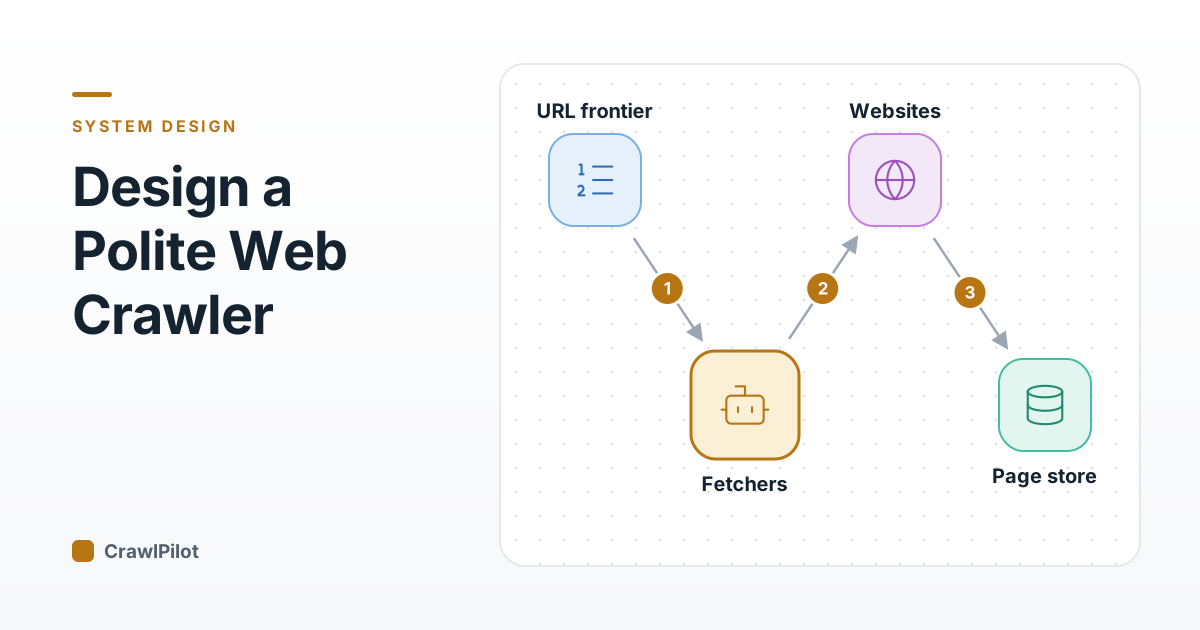
Every page a crawler downloads gets paid for twice. You pay in bandwidth and compute; the site owner pays in server time they never agreed to spend. The first bill is yours to scale. The second sets the rules: a crawler that hammers a small shop gets its IPs blocked, its user agent written into robots.txt, and in 2026 its traffic sorted into a category the CDN blocks by default. So the interview answer that starts from "how many machines do I need" is starting from the wrong bill. Start from how hard you're allowed to hit any one host, and the rest of the design falls out of that.
Whose Servers Set the Speed Limit
Take an illustrative target of one billion HTML pages a day. Every number below is an assumption chosen to make the arithmetic visible, not a measurement of any real crawler:
- 1,000,000,000 ÷ 86,400 s ≈ 11,600 fetches a second on average; at a 2× peak, about 23,000.
- At an assumed 100 KB of HTML per page, the peak is about 18.5 Gbit/s of download, and a day is 100 TB raw. Compressed to a quarter, about 25 TB a day to keep.
- Now the politeness constraint. If each host gets at most one request every 5 seconds, then 23,000 fetches a second only stays polite when about 116,000 different hosts are due for a fetch at the same moment.
That last line is the one that matters. Bandwidth and storage are a purchasing problem. Keeping a hundred thousand hosts in rotation, each on its own clock, is a scheduling problem, and it lives in one component: the URL frontier. Move the sliders and watch which number grows fastest:
At one request per host every 5 s, 23,148 fetches a second only stay polite if about 115,741 different hosts are due at once. The frontier's job is to keep that many hosts in rotation.
Illustrative assumptions only. Counts HTML fetches; leaves out robots.txt and DNS lookups, retries, rendered (headless) pages, images and the link graph. KB here means 1,000 bytes.
The Crawler Everyone Draws First
The whiteboard version has five boxes and one loop. Seed URLs go into a queue, fetchers pull from it, a parser extracts links, and the links go back into the same queue.
Nothing in it is wrong. It just has no idea that the URLs in the queue belong to different people. A product page links to forty other product pages on the same site, so the parser enqueues forty same-host URLs in a row, and the next forty idle fetchers all hit that one shop together. That's the failure, and it's worth seeing rather than taking on faith.
Put the Naive Frontier Under Load
The simulator below crawls 60 made-up URLs on five hosts, in the order a parser would discover them: in same-host bursts. Each host allows one request start every D seconds. Start on Global FIFO, press Replay, and watch the red blocks: each is a request that started sooner than the host allows. Then try the other two designs. Arrow keys on the timeline step one simulated second.
Idle fetchers take the head of one queue, whatever its host.
| Host | Queued | Peak rate vs limit | Violations |
|---|---|---|---|
| shop.example | 0 | 10+ / 0.50 req/s | 22 over the limit |
| news.example | 0 | 10+ / 0.50 req/s | 9 over the limit |
| blog.example | 0 | 10+ / 0.50 req/s | 6 over the limit |
| docs.example | 0 | 10+ / 0.50 req/s | 6 over the limit |
| wiki.example | 0 | 10+ / 0.50 req/s | 6 over the limit |
Illustrative: 60 made-up URLs on five hosts, fixed fetch times of 0.5–0.9 s, and politeness read as one request start per host per delay.
Three things to notice, all from the simulator's own illustrative numbers:
- 01Global FIFO is fast because it's rude. With 4 fetchers and a 2-second delay it finishes at about 5.5 pages a second, and almost every request breaks the limit. Fetchers land on the same host in the same tenth of a second.
- 02Adding a wait to the single queue fixes politeness and kills throughput. When the head of the queue is a host that isn't due, every fetcher waits behind it: head-of-line blocking. Throughput drops to about 0.6 pages a second, and adding fetchers changes nothing.
- 03Per-host queues stay polite and roughly double that. Fetchers skip to whichever host is due soonest. The run now ends when the biggest host drains: shop.example's 24 URLs at one every 2 seconds. With only five hosts, polite throughput can never exceed five requests per delay window. A real crawler escapes that ceiling the only way available: more hosts in rotation, which is the 116,000 from the sizing above.
Two Queues Deep: Priority in Front, Politeness Behind
The fix that survives scale was described in Mercator, Heydon and Najork's crawler from 1999: the frontier is a set of FIFO subqueues, and the subqueue a new URL goes into "is determined by the URL's canonical host name", one subqueue per worker thread, so at most one thread downloads from any given server. Modern write-ups split that into two layers. Front queues decide what is worth fetching next. Back queues, one per host, decide when it is polite to fetch it. Follow one link through the whole path:
- The parser resolves the link against the page's base URL. It arrives with a tracking parameter and a fragment the server never sees.
- The normaliser lowercases scheme and host, drops the default port and the fragment, and strips parameters known to be noise, so one page has one spelling.
- The seen-URL check drops anything already crawled or queued. On a real crawl most extracted links are repeats: navigation, footers, pagination.
- A survivor gets a priority (site importance, depth, how often it changes) and waits in a front queue; a router moves it into its host's queue.
- Each host queue carries a next-allowed time. A fetcher takes the host whose time comes soonest, so no host gets two requests inside its delay.
- Before the GET, the fetcher resolves DNS from a cache and checks the host's cached robots.txt. Only then does it download the page.
6 steps. Press Play to walk through them, or click any part of the diagram.
Two details in step ⑥ deserve a word. Mercator found that DNS, not HTTP, was its bottleneck: blocking lookups took 87% of each worker thread's elapsed time until the team wrote a multi-threaded resolver, which cut that to 25% (Heydon and Najork, §3.7). So keep a DNS cache per frontier shard and resolve asynchronously. And the politeness delay shouldn't be a constant: when a host answers 429 or 503, back that host off, and honour Retry-After when it's sent (RFC 6585 §4). Google tells site owners to return 500, 503 or 429 precisely to slow Googlebot down (Google), so a crawler that ignores those codes is ignoring the one signal sites have been told to use.
The front layer is where the ordering choice lives, and it's a real fork:
- Trivial to build and reason about
- Finds shallow, well-linked pages early
- Spends the same effort on a spam farm as on a news homepage
- One giant site can flood the queue
- Fine for a single-site crawl or a bounded seed list
- Fetches what matters first when you can't fetch everything
- Lets re-crawls compete fairly with new URLs
- Needs a scoring signal you must maintain
- Low-priority URLs can starve without ageing
- Score from site importance, depth and change rate, plus a bonus for time waited
Verdict: Use priority for anything web-scale, and age low scores upward so nothing waits forever. Breadth-first is a special case of it with every score equal.
Asking Permission: robots.txt Under RFC 9309
Before the first GET to a host, the fetcher needs that host's robots.txt. Since September 2022 the format is a proposed standard, RFC 9309, and the edge cases are the parts interviewers like:
- Caching. You may cache it, but "crawlers SHOULD NOT use the cached version for more than 24 hours, unless the robots.txt file is unreachable" (§2.4). Store it next to the host's queue so the check is a memory lookup.
- Errors split two ways. A
4xxmeans unavailable: the crawler may access anything. A5xxor network failure means unreachable: assume complete disallow until it comes back (§2.3.1.3–2.3.1.4). Getting these backwards means hammering a struggling site the moment it fails. - Limits. Follow at least five redirects, and parse at least 500 KiB (§2.3.1.2, §2.5).
- Matching. A bot uses its own user-agent group over
*, and the longest matching rule wins (§2.2.2). - Crawl-delay isn't in the RFC. Google says it doesn't support the field (Google); Cloudflare's crawl endpoint honours it (Cloudflare). Treat it as a hint that can only make you slower.
In 2026 most of a robots.txt file's new lines name AI crawlers. Here is a shop that wants search traffic but not model training. Try /products/blue-kettle, then /cart/, and see which bots each rule catches:
Paste any site's file from https://its-domain/robots.txt. It's checked in your browser; nothing is fetched or sent.
- BlockedGPTBotOpenAITrainingLine 7: Disallow: / (its own group)
Crawls content that may be used to train OpenAI's models. Docs
- AllowedOAI-SearchBotOpenAISearchLine 13: Allow: / (the * group)
Decides whether your pages can appear in ChatGPT search. Docs
- AllowedChatGPT-UserOpenAIUser fetchLine 13: Allow: / (the * group)
Fetches pages when a ChatGPT user asks; OpenAI says robots.txt rules may not apply. Docs
- BlockedClaudeBotAnthropicTrainingLine 7: Disallow: / (its own group)
Collects content that may be used for model training. Docs
- AllowedClaude-SearchBotAnthropicSearchLine 13: Allow: / (the * group)
Indexes content for Claude's search results. Docs
- AllowedClaude-UserAnthropicUser fetchLine 13: Allow: / (the * group)
Fetches pages when a Claude user asks. Docs
- BlockedGoogle-ExtendedGoogleTrainingLine 7: Disallow: / (its own group)
Controls use for Gemini training and grounding; doesn't affect Google Search. Docs
- AllowedApplebot-ExtendedAppleTrainingLine 13: Allow: / (the * group)
Controls use of Applebot's crawl for Apple's generative AI training; it doesn't crawl. Docs
- AllowedPerplexityBotPerplexitySearchLine 13: Allow: / (the * group)
Surfaces and links sites in Perplexity's search results. Docs
- AllowedPerplexity-UserPerplexityUser fetchLine 13: Allow: / (the * group)
Fetches pages a user asks for; Perplexity says it generally ignores robots.txt. Docs
- BlockedMeta-ExternalAgentMetaTrainingLine 7: Disallow: / (its own group)
Crawls for uses such as training AI models or indexing content. Docs
- AllowedMeta-ExternalFetcherMetaUser fetchLine 13: Allow: / (the * group)
Fetches links a user asks for; Meta says it may bypass robots.txt. Docs
- BlockedCCBotCommon CrawlTrainingLine 7: Disallow: / (its own group)
Builds Common Crawl's open web corpus, widely used to train models. Docs
The design point: your crawler's user-agent token is its contract with the site. If it does several jobs (search indexing and training data), sites can't express a different answer for each unless you split the jobs across separate tokens. That split is the whole story of Cloudflare's 2026 changes, below. And remember what robots.txt is legally: a request, not a lock. A federal judge held in December 2025 that ignoring it isn't DMCA circumvention, which removes one legal theory and leaves the others (our write-up).
Seen It Already: URLs, Bytes and Near-Copies
Deduplication happens twice, on different keys. Before fetching, on the URL: have we queued this address already? After fetching, on the content: have we stored these bytes, or nearly these bytes, under a different address? Step through both:
- Every canonical URL is checked against a Bloom filter. A 'no' is certain: this URL was never added.
- A 'maybe' can be wrong. For URLs that matter (high priority, seed hosts) confirm against the exact on-disk store before dropping them.
- New URLs get fetched. A hash of the normalised body catches exact copies: mirrors, session-ID variants, the same page under two paths.
- A SimHash fingerprint catches near-copies: the same article with a different ad block or timestamp. Fingerprints a few bits apart mean the same content.
- Only genuinely new content is stored and parsed for links, so a duplicate page can't feed the frontier more duplicates.
5 steps. Press Play to walk through them, or click any part of the diagram.
The URL side is a memory question. An exact set of ten billion URLs at roughly 100 bytes each is about a terabyte; a Bloom filter at a 1% false-positive rate needs about 9.6 bits per URL, so roughly 12 GB for the same ten billion (standard Bloom filter sizing; the URL count and length are illustrative). The catch is which way the error points. In a fraud blocklist a false positive costs an extra lookup. In a crawler a false positive means a URL the filter wrongly thinks it has seen, so that page is never fetched and nothing reports it missing. Choose the rate as "how many pages am I willing to lose silently", and that's why step ② confirms the important ones.
- Never wrong
- Doubles as the URL's crawl history
- Every check is a disk read unless you batch
- Hundreds of GB to TB at web scale
- Microsecond checks for every extracted link
- About 10 bits per URL at 1% error
- False positives silently drop pages
- Can't delete or list entries
Verdict: Bloom filter in front for the flood of extracted links, exact store behind it for anything a false positive would hurt.
The content side is older than it sounds. Mercator kept a 64-bit fingerprint per document for exact copies and found that 8.5% of successful downloads in an eight-day crawl were duplicates (Heydon and Najork, §6). Exact hashes miss pages that differ only in an ad or a date, so researchers at Google showed that Charikar's SimHash works for near-duplicates at multi-billion-page scale, with a fast way to find stored fingerprints that differ in at most k bits (Manku, Jain and Das Sarma, WWW 2007). For URL normalisation itself, start from the syntax-based rules in RFC 3986 §6 and add per-site rules (which query parameters are noise) learned from content hashes that keep colliding.
Coming Back: The Re-Crawl Loop
A page fetched once is a snapshot. Keeping an index fresh means fetching it again, and every re-fetch competes with new URLs for the same politeness budget. So re-crawls go through the same frontier, with a priority set by how often that page actually changes.
- The scheduler releases URLs whose next-visit time has passed. They enter the frontier as ordinary work.
- The fetcher sends the stored ETag or Last-Modified back. If nothing changed, the server can answer 304 with no body.
- A 304, or a 200 whose content hash matches, counts as unchanged. A 200 with a new SimHash counts as changed.
- The result is recorded, and the interval adapts: changed means come back sooner, unchanged means back off, within a floor and a ceiling.
4 steps. Press Play to walk through them, or click any part of the diagram.
Conditional requests are cheap to support and save the site the most: a 304 Not Modified carries no body (RFC 9110 §15.4.5). Sitemaps help too, with care: Google says it uses <lastmod> only when it's "consistently and verifiably" accurate, and ignores <priority> and <changefreq> (Google). Your scheduler should take the same stance: trust a site's hints in proportion to how often they've matched what you observed.
Splitting the Work by Host
One machine can't hold 116,000 host clocks, a 12 GB filter and 23,000 open connections, so the frontier is sharded. The key is the host (or registered domain), for the same reason a rate limiter shards by the key it limits: every politeness decision about shop.example then happens on one shard, with no cross-machine coordination. A link to another host found on any shard is forwarded to the owning shard. Assembled:
Three consequences of host sharding. Hot hosts are a skew problem: a site with millions of URLs pins one shard's queue but not its fetchers, since that host only gets one request per delay anyway. Rebalancing moves clocks: when a shard dies, its hosts move with their next-allowed times and robots.txt cache, or the new owner will treat every host as fresh and burst them. Storage splits by access pattern: raw pages go to object storage in large compressed batch files, while URL state (last fetch, ETag, hashes, next visit) lives in a key-value store keyed by URL and partitioned by the same host hash.
Traps, Timeouts and Hostile Pages
The web contains infinite URL spaces, most of them accidental. A calendar with a "next month" link, faceted search that permutes filters, session IDs in paths, relative links that nest /a/b/a/b/…. None of them break the crawler loudly. They fill a host's queue with junk and spend its politeness budget on pages nobody wants.
| Hazard | What it looks like | Guard |
|---|---|---|
| Infinite calendar or pagination | Endless ?month= or ?page= values | Depth and per-host URL budgets; drop parameters whose pages hash identically |
| Path loops | /a/b/a/b/a/b/… | Cap path length and repeated segments |
| Session IDs in URLs | Same page, new URL each visit | Normalise known session parameters; content hash catches the rest |
| Slow or huge responses | A server that trickles bytes forever | Connect, first-byte and total timeouts; a maximum body size |
| Soft 404s | 200 OK on a "not found" template | SimHash against the host's known error page |
| Struggling host | Rising latency, 429, 503 | Lengthen that host's delay automatically; honour Retry-After |
The per-host budget does double duty: it's the trap guard and the fairness guarantee. A host can only consume what the frontier assigns to it, however many URLs it generates.
Showing Your Papers in 2026
Everything above is the classic answer. Three things changed it in 2026, and all three are about identity rather than throughput.
Sites now sort crawlers by purpose. Cloudflare classifies AI crawler traffic as Search, Agent or Training (Cloudflare). From September 15, 2026, a domain newly onboarding is offered a preset; for ad-supported sites it allows Search, sets Training to "Disallow AI Training" (a no-training preference published in robots.txt), and blocks Agent crawlers on pages with ads. Googlebot, Applebot and Bingbot are designated "Accountable" mixed-use crawlers that stay allowed for search under that setting (Cloudflare; our analysis of the deadline). For a crawler designer the lesson is structural: one token doing several jobs gets the strictest answer any of those jobs earns. Give each purpose its own user-agent token and its own robots.txt group.
Honest self-identification is the norm, even for the infrastructure vendors. Cloudflare's own crawl endpoint, launched March 10, 2026, "self-identifies as a bot", honours robots.txt including crawl-delay, and "cannot bypass Cloudflare bot detection or captchas" (Cloudflare changelog). If the company that runs the bot wall ships a crawler that announces itself and accepts being stopped, a design that rotates browser user agents to look human is choosing a fight, not a feature.
Identity is becoming cryptographic. A user-agent string can be copied by anyone. The IETF's Web Bot Auth working group, chartered to cryptographically authenticate automated clients from search crawlers to AI agents (charter), adopted draft-ietf-webbotauth-httpsig-protocol as its working draft: version -00, published September 1, 2026, by authors from Cloudflare and Google. It's an Internet-Draft, not a standard, and it can still change. The mechanism builds on HTTP Message Signatures (RFC 9421): each request carries Signature, Signature-Input and Signature-Agent headers, the signature must cover the target authority plus created and expires, uses the tag web-bot-auth, and the Signature-Agent URL points at a key directory served from /.well-known/http-message-signatures-directory. Cloudflare already accepts these signatures for verified bots, with Ed25519 keys (Cloudflare docs). One signed fetch:
4 messages. Press Play, or pick one, to see exactly what is sent.
What this adds to the design is small and concrete. A signing service holds the private keys (in a KMS, never on fetcher disks) and signs on the fetch path with short expiry. The key directory is a tiny public endpoint you must keep up with key rotation. And the frontier gains a per-host identity policy: sign everywhere, keep separate tokens per purpose, and record per host which identity was refused so the scheduler stops spending budget on hosts that said no.
Q1Your crawler gets a 503 when fetching shop.example/robots.txt. What does RFC 9309 say to do?
Q2In the simulator, why does 'Global FIFO, wait' get slower instead of faster when you add fetchers?
Q3What does a Bloom filter false positive cost a crawler?
Keep This Page
Sizing
- Pages a day ÷ 86,400 = fetches a second; multiply by a peak factor.
- Hosts needed in rotation = peak fetches a second × per-host delay.
- Bandwidth and storage are purchases; host rotation is the design problem.
Frontier
- Front queues set priority; back queues, one per host, set politeness.
- A fetcher takes the host whose next-allowed time comes soonest.
- Back off on 429 and 503, honour Retry-After, cache DNS per shard.
robots.txt (RFC 9309)
- Cache for at most 24 hours unless the file is unreachable.
- 4xx means crawl freely; 5xx or network failure means assume complete disallow.
- Own group over *, longest match wins; Crawl-delay is outside the RFC.
Dedup
- Normalise URLs first, then a Bloom filter, then an exact store for important URLs.
- A Bloom false positive silently skips a page; size it for acceptable loss.
- Exact hash for copies, SimHash for near-copies.
Re-crawl and scale
- Re-crawls share the frontier; conditional GETs make unchanged pages cheap.
- Shard by host so politeness never needs cross-machine coordination.
- Per-host URL budgets stop traps and keep fairness.
Identity in 2026
- One user-agent token per purpose: search, training, agent.
- Self-identify honestly; even Cloudflare's crawl endpoint can be stopped by bot detection.
- Web Bot Auth signs requests with RFC 9421 signatures; it's an IETF draft, not a standard.
Sources
- Heydon and Najork, Mercator: A Scalable, Extensible Web Crawler (per-host FIFO subqueues, DNS bottleneck, 8.5% duplicates)
- Manku, Jain and Das Sarma, Detecting Near-Duplicates for Web Crawling, WWW 2007
- IETF Web Bot Auth working group, charter and draft-ietf-webbotauth-httpsig-protocol-00
- Cloudflare, Web Bot Auth verification
- Cloudflare, Crawl endpoint changelog, March 10, 2026

