Meta's New Crawling Terms: What Publishers With a Facebook Page Agree To on November 20
Meta's revised Commercial Terms let it crawl sites 'associated with' any business account. It dropped the word 'train' after an outcry and moved the date to November 20. What the clause says, what changed, and what robots.txt can and can't do about it.

"You authorize us (or any entity acting on our behalf) to use automated software (such as web scrapers, bots, robots, spiders, crawlers, and user agents) and create test credentials to access, index, cache, analyze, collect, retrieve, or crawl the domains, web pages, or URLs … that are associated with your products or services." That is the opening of one bullet under "Licenses & Rights You Provide Meta" in Meta's preview of its new Commercial Terms, effective November 20, 2026.
Nobody signs it. Under the terms' update rule, you agree "by continuing any access or use of any Meta Company Products for business or commercial purposes after any notice of an update" (Meta). Virtually every news organization has at least one Meta business account, as Nieman Lab pointed out about itself, so the question in October was what that one bullet lets Meta do with a newsroom's website. Meta has edited the bullet once and moved its start date once. What's left is a contract-shaped permission sitting next to a robots.txt-shaped preference, and those are not the same kind of control.
This is not legal advice; it's a reading of public documents and reporting, with links to all of them.
- Early Oct 2026Meta notifies business users
Updated Commercial Terms and Self-Serve Ad Terms announced in a blog post and in Meta Business Suite, effective October 30.
PPC Land - Oct 15, 2026Nieman Lab reads the clause
Three legal experts say it could be used to argue Meta may scrape news sites and train AI on them.
Nieman Lab - Oct 16, 2026Pushback from both sides
Meta's Andy Stone says it is 'not about scraping news sites'; the UK News Media Association calls it a 'shameless landgrab'.
Search Engine Journal - Oct 17, 2026'Train' comes out
Meta removes the 'may use any content' sentence and limits the purpose to advertising and business products.
TechCrunch - Oct 19–20, 2026The UK preview lags
SEJ finds the old wording still in the UK-English Self-Serve Ad Terms preview; Relevant Audience finds it revised a day later.
Relevant Audience - Oct 23, 2026Date moves to November 20
Meta says it needs more time to explain what is and isn't changing. The European Publishers Council asks the Commission to act before then.
PPC Land - Oct 26, 2026 · pendingNews/Media Alliance deadline
The US publishers' group's deadline for a public response from Meta.
PPC Land - Nov 20, 2026 · pendingThe terms take effect
Continued business use counts as acceptance.
The bullet, before and after October 17
The version Meta announced in early October went further than the text above. After the crawl permission, it said: "Meta may use any content from such domains, web pages or URLs to provide, develop, improve, research, train and maintain the integrity of, the Meta Company Products, services and features provided under these Commercial Terms" (PPC Land, quoting the UK-English text). The word that set off the reporting was "train", sitting in a contract that reaches far past advertisers: The Register lists managing a Page or a business Group, listing products, using a product catalog and using Ads Manager or Meta Business Suite among the uses the terms cover.
Two days after Nieman Lab's story, Meta removed that sentence. "We've heard you and want to clarify: the crawling terms we consolidated only applied to our ads and business products," the company said, adding that "it does not change how Meta uses web crawlers" (TechCrunch). Here is what that edit did and didn't touch:
- Names training outright
- “…use any content from such domains, web pages or URLs to provide, develop, improve, research, train…”
- Integrity of “the Meta Company Products, services and features”
- Crawl permission covers sites “associated with your products or services”
- No “train”, no “may use any content”
- Same crawl permission, test credentials and “associated with” scope
- Still no mention of robots.txt
- “…in order to provide, develop, improve, research, and maintain advertising and business products”
- “…and maintain the integrity and security of Meta Company Products.”
Verdict: Meta narrowed why it may crawl. It didn't narrow what it may crawl, who may do it, or how.
The compare card is the summary. To see the edit word for word, switch between the two texts below; each part of the clause is labelled kept, removed, added or narrowed. Pick a part to see why it matters.
Four of the eight parts survive untouched, and they are the ones that decide what reaches Meta's servers: who may crawl ("any entity acting on our behalf"), with what (automated software and test credentials), where (anything "associated with your products or services") and how often ("periodically pull updates"). What changed is the stated reason. Lawyers Nieman Lab went back to weren't persuaded the reason matters much. Media lawyer Matt Topic said "'develop' is broad enough to include 'train'" and that "business product" doesn't appear to be a defined term; Cornell's James Grimmelmann said the purposes are "still broad enough to drive a truck through" (Search Engine Journal, quoting Nieman Lab).
Two details make the edit less clean than it sounds. First, sources disagree on when it reached every locale: SEJ found the old sentence still in the UK-English Self-Serve Ad Terms preview on October 19, and Relevant Audience found the revised wording on the same page on October 20. Second, advertisers had already granted a version of this. SEJ reports that the current Self-Serve Ad Terms (August 22, 2025) give Meta a right to crawl an advertiser's domains when it places an ad order, with uses that include "research and training" (Search Engine Journal). What's new in 2026 is the reach: the Commercial Terms cover businesses that never buy an ad.
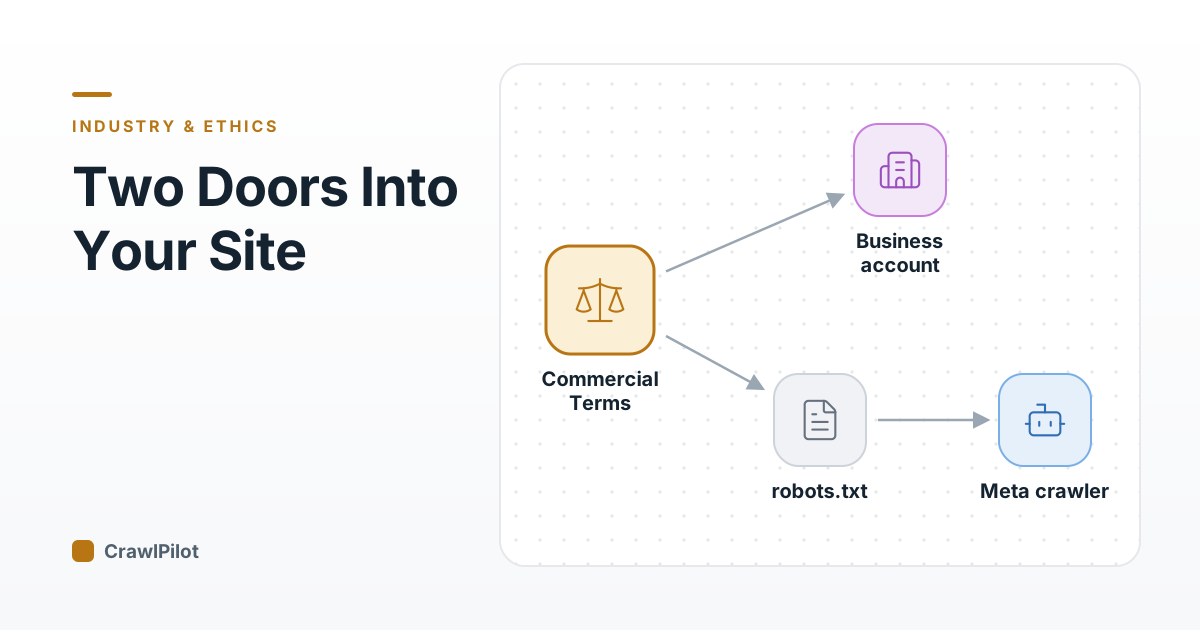
Two doors into the same newsroom
Meta's defence leans on a control publishers already know. Its spokesperson told Nieman Lab that "content owners can still manage how their content is accessed by using robots.txt", and that the first version "wasn't clear" that robots.txt preferences are respected; the updates don't give Meta "new rights that supersede those preferences" (SEJ). Andy Stone said on X that the clause is about pulling accurate information on products for sale on third-party sites (SEJ).
That defence describes one route by which a page reaches Meta. The contract opens a second. Step through both:
- Route A, the one Meta points to. A documented crawler such as Meta-ExternalAgent reads robots.txt first; Meta's docs say to block one, add a disallow for it.
- If robots.txt allows it, the crawler fetches pages. Meta's docs say Meta-ExternalAgent crawls 'for use cases such as training foundation AI models'.
- Route B. The publisher keeps managing its Facebook Page after November 20. Under the update rule, that is agreement.
- The terms authorize automated software and test credentials for sites 'associated with your products or services'. They name no crawler and never mention robots.txt.
- Same crawler, two instructions: a permission in writing, next to a preference in a text file. Which one governs if they conflict is the open question.
5 steps. Press Play to walk through them, or click any part of the diagram.
Steps 1 and 2 are how AI crawling already works: a crawler asks, the site's robots.txt answers, and the answer is a request rather than a lock. Steps 3 and 4 are new. The permission doesn't come from your server at all; it comes from your social media manager logging into Business Suite on November 21. Step 5 is where publishers and Meta part ways.
What a robots.txt line can and can't do here
Start with what it can do, because it's real. Meta publishes its crawlers and their tokens (Meta for Developers):
- Meta-ExternalAgent "crawls the web for use cases such as training foundation AI models", and indexes content to improve products.
- Meta-ExternalAds "crawls the web for use cases such as improving advertising and other business-related products and services": the same purpose the revised clause now names.
- Meta-WebIndexer improves Meta AI search results, and allowing it helps Meta link to your content in answers.
- FacebookExternalHit fetches shared links for their title, description and image (the preview card), and "might bypass robots.txt when performing security or integrity checks".
- Meta-ExternalFetcher "fetches individual links at a user's request" and "may bypass robots.txt" for that reason.
Meta says changes take up to 24 hours to apply, because its crawlers may cache robots.txt for that long. Paste your own file below, or edit the sample, which disallows the training and ads crawlers and leaves everything else open:
Paste any site's file from https://its-domain/robots.txt. It's checked in your browser; nothing is fetched or sent.
- AllowedGPTBotOpenAITrainingLine 14: Allow: / (the * group)
Crawls content that may be used to train OpenAI's models. Docs
- AllowedOAI-SearchBotOpenAISearchLine 14: Allow: / (the * group)
Decides whether your pages can appear in ChatGPT search. Docs
- AllowedChatGPT-UserOpenAIUser fetchLine 14: Allow: / (the * group)
Fetches pages when a ChatGPT user asks; OpenAI says robots.txt rules may not apply. Docs
- AllowedClaudeBotAnthropicTrainingLine 14: Allow: / (the * group)
Collects content that may be used for model training. Docs
- AllowedClaude-SearchBotAnthropicSearchLine 14: Allow: / (the * group)
Indexes content for Claude's search results. Docs
- AllowedClaude-UserAnthropicUser fetchLine 14: Allow: / (the * group)
Fetches pages when a Claude user asks. Docs
- AllowedGoogle-ExtendedGoogleTrainingLine 14: Allow: / (the * group)
Controls use for Gemini training and grounding; doesn't affect Google Search. Docs
- AllowedApplebot-ExtendedAppleTrainingLine 14: Allow: / (the * group)
Controls use of Applebot's crawl for Apple's generative AI training; it doesn't crawl. Docs
- AllowedPerplexityBotPerplexitySearchLine 14: Allow: / (the * group)
Surfaces and links sites in Perplexity's search results. Docs
- AllowedPerplexity-UserPerplexityUser fetchLine 14: Allow: / (the * group)
Fetches pages a user asks for; Perplexity says it generally ignores robots.txt. Docs
- BlockedMeta-ExternalAgentMetaTrainingLine 3: Disallow: / (its own group)
Crawls for uses such as training AI models or indexing content. Docs
- AllowedMeta-ExternalFetcherMetaUser fetchLine 14: Allow: / (the * group)
Fetches links a user asks for; Meta says it may bypass robots.txt. Docs
- AllowedCCBotCommon CrawlTrainingLine 14: Allow: / (the * group)
Builds Common Crawl's open web corpus, widely used to train models. Docs
Now what it can't do. Add User-agent: meta-externalfetcher with Disallow: / to the sample and the checker shows it blocked, with a warning: Meta says user-requested fetches may bypass robots.txt. More important, robots.txt speaks to user agents, and the contract doesn't name any. It covers "any entity acting on our behalf", and none of its text says a disallow line limits what you granted. SEJ notes it's unclear whether robots.txt settings limit what a business agrees to when it accepts the terms (SEJ), and University of Wisconsin law professor Benjamin Sobel told Nieman Lab that following robots.txt is voluntary and gives a site no enforceable legal right (SEJ). A December 2025 federal ruling reached a related conclusion from another direction: robots.txt is not a technological measure that controls access (our write-up).
So a robots.txt block is evidence of what you want and an instruction Meta's documented crawlers say they follow. Against a contract that says you authorized crawling, it's an argument rather than an answer. The European Publishers Council put it bluntly in its statement to the Commission: "Technical controls over crawler access cannot substitute for clear, enforceable contractual limits" (PPC Land). Meta's on-record answer is the opposite: the updates don't supersede robots.txt preferences. Until that sentence appears in the terms, it's a spokesperson's statement, not a clause.
Meta's account against the publishers'
Meta's position, in its own words across the week: the update consolidates terms rather than adding rights, "does not change how Meta uses web crawlers", applies "only" to ads and business products, and "is not about scraping news sites" (spokesperson Daniel Roberts to The Verge, via SEJ). SEJ also reports that Meta's Business Help Center described the update as moving the Ad Creative Generative AI Terms into the Self-Serve Ad Terms to "reduce overlap", without mentioning crawling or training (SEJ). On October 23 it told Reuters it needed more time to explain to partners what is and isn't changing, and moved the effective date to November 20 (PPC Land). Meta's preview page now shows "Effective Date: November 20, 2026" (Meta).
The publishers' position has three parts:
- 01The terms are take-it-or-leave-it. The only way to refuse is to stop using Meta's business products; neither version offers a partial opt-out (PPC Land). Danielle Coffey of the News/Media Alliance called the terms "outrageous and probably illegal" and an abuse of market power (The Register). Santa Clara law professor Eric Goldman said users need a genuine option to reject amended terms (same source).
- 02One deleted word isn't an exclusion. The European Publishers Council says "removing that one word does not establish an express exclusion of AI training, fine-tuning, grounding", that "the authorisation remains extensive", and that "little has changed in substance." It asked the Commission to look at the terms under the Digital Markets Act and competition law, and failing interim measures, to get Meta to postpone the provisions (PPC Land).
- 03Collection can't be undone. The same statement warns about content once "collected and incorporated into datasets, models or competing services." In the UK, News Media Association chief executive Theo Bamber called the original a "shameless landgrab attempt from Meta to scrape anything and everything from news publisher and business websites" and asked ministers and regulators to intervene (InPublishing).
Our read: Meta's narrowing is real but small. The purpose clause got shorter; the permission to send automated software with test credentials to an undefined set of "associated" sites got no shorter at all. If Meta means what its spokesperson said about robots.txt, the cheapest fix is a sentence in the terms saying so. It hasn't added one.
Q1A publisher disallows Meta-ExternalAgent in robots.txt and keeps running its Facebook Page after November 20. What has it done?
Q2What did Meta's October 17 edit remove?
Q3Which Meta crawler does Meta say may bypass robots.txt because a user asked for the page?
Your list for the next four weeks
If your organization publishes anything and touches Meta's business tools, here's what to do before November 20:
- 01List every Meta business asset you have. Pages, ad accounts, catalogs, business Groups, Business Suite logins and WhatsApp channels. Any of them can make you a business customer (The Register).
- 02Read the preview yourself, in your locale. Both the Commercial Terms preview and the Self-Serve Ad Terms. The UK text lagged the US text by at least a day.
- 03Set robots.txt on purpose. Decide on
meta-externalagent,meta-externaladsandmeta-webindexerone by one; leavefacebookexternalhitalone if you want link previews. Allow 24 hours. - 04Watch your logs for Meta's user agents on paywalled or logged-in paths. Meta declined to say whether test credentials would get past paywalls or paid content (SEJ).
- 05Decide whether you accept. The only exit the terms offer is to stop business use. If you object, put it in writing and route it through your trade body; the EPC, the News/Media Alliance and the UK NMA are all pressing Meta and regulators now.
- 06Check back before the 20th. The News/Media Alliance's deadline for Meta's answer is October 26, and the EPC wants a Commission response before November 20. The text may change again.
The clause
- Meta may crawl sites 'associated with your products or services', using automated software and test credentials.
- Accepted by continued business use after notice; there's no partial opt-out.
- Effective date moved from October 30 to November 20, 2026.
What changed
- Removed on Oct 17: 'may use any content … to provide, develop, improve, research, train'.
- New purpose: advertising and business products, an undefined term.
- Unchanged: who, with what, which sites, and repeat visits.
robots.txt
- Disallow meta-externalagent (training) and decide on meta-externalads and meta-webindexer.
- Keep facebookexternalhit for link previews; Meta-ExternalFetcher may bypass robots.txt.
- The terms never mention robots.txt; Meta says it won't supersede your preferences.
Before the 20th
- List every Page, ad account, catalog and Business Suite login.
- Read the Commercial and Self-Serve Ad Terms previews in your own locale.
- Watch logs for Meta user agents on paywalled paths.
- Decide whether to accept, and put any objection in writing.

